


Good morning, and welcome to The Cargo Club!
Happy Frankenstein Friday, everyone.
Yes, that’s a real holiday, and it’s dedicated to one of the greatest horror stories ever written, which, fittingly, is mostly about a guy making a terrible decision and refusing to take responsibility for it.
The story itself has a pretty fascinating origin.
In 1816, an 18-year-old Mary Shelley was vacationing in Switzerland with a group of writers, including Lord Byron, when miserable weather forced everyone indoors.
Naturally, they decided to entertain themselves with a ghost-story competition.
Not one to be outdone by her peers, Mary casually invented one of the most influential horror stories of all time.
Not bad for a teenager stuck inside on vacation.
At 18, I considered successfully making a doctor’s appointment without my mom’s help a pretty significant accomplishment.
– Greyson Harris

America’s small trucking companies are running out of financial runway, and the industry’s prolonged freight recession is collecting casualties.
According to Bloomberg, 221 trucking companies have filed for bankruptcy in 2026, continuing a three-year wave of failures at levels not seen in decades.
Between soaring diesel prices, rising insurance premiums, and expensive equipment loans, smaller carriers are discovering that keeping the wheels turning doesn’t necessarily mean making money.
Unfortunately, the bank still expects its payment regardless of how the freight market is feeling.
A recent survey from Truckstop and Bloomberg Intelligence highlights just how difficult things have become for smaller carriers, typically those operating 20 trucks or fewer:
Much of the trouble traces back to the pandemic freight boom, when high demand, cheap financing, and generous lending encouraged thousands of new carriers to enter the industry. Then freight demand cooled, spot rates collapsed, and suddenly small trucking companies had a major business problem on their hands.
Now, even the survivors are getting hammered by elevated operating costs and high-interest debt. Larger carriers can absorb some of those expenses or negotiate better rates, but a five-truck operation doesn’t exactly have the same financial cushion as one of the big boys.
Michigan-based Stoneman Trucking is a particularly painful example.
After 27 years in the industry, owner Justin Stoneman filed for bankruptcy protection in May and is now moving toward complete liquidation. At its peak, the company’s dozen or so trucks generated more than $3 million in annual revenue hauling agricultural freight throughout the Midwest.
Unfortunately, revenue doesn’t mean much when expenses are eating everything in sight.
Stoneman accumulated $125,000 in merchant cash advances to keep operations running during the downturn. Following an accident involving one of his drivers, his insurer quoted him $155,000 to cover just two trucks and three trailers.
That was effectively the final nail in the company’s coffin.
The broader industry is facing similar pressures, with freight fraud, rising equipment costs, and tighter margins making it increasingly difficult for smaller operations to compete with larger carriers.
As more small carriers exit the industry, the resulting reduction in capacity could eventually help support higher freight rates. But that’s little consolation for operators who spent years building businesses only to watch the financial math stop working.
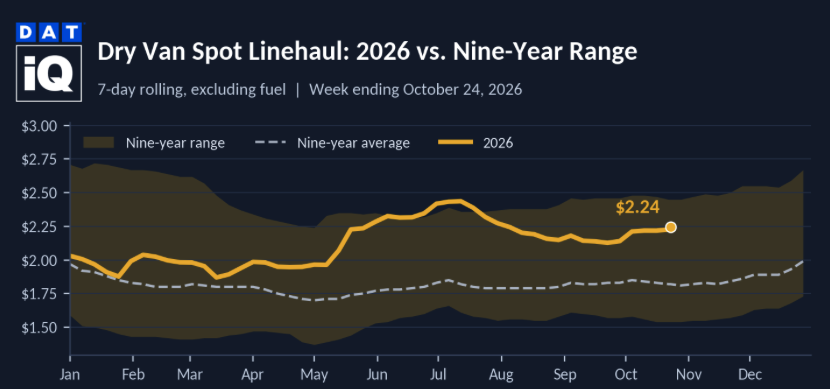
The dry van spot market cooled last week, with rates slipping as load postings declined. But before shippers start celebrating cheaper freight, there’s a catch: truck capacity remains stubbornly tight.
Demand may be taking its foot off the gas, but the supply of available trucks isn’t exactly racing to catch up, keeping rates comfortably above historical levels.
All rates exclude fuel.
The numbers paint a pretty clear picture. Freight demand has cooled slightly, but the real story is the shortage of available trucks. With considerably fewer carriers competing for loads, rates have managed to stay elevated despite softer activity.
Normally, declining demand would give shippers some negotiating power. Unfortunately for them, the capacity situation didn’t get that memo.
California and the Lower Atlantic were the only major regions to post weekly gains, each climbing $0.02 per mile. California led the pack at $2.58 per mile, while the Southeast suffered the steepest decline, dropping $0.06. Most other regions moved lower, although year-over-year comparisons remain firmly positive.
Looking ahead, DAT expects national spot rates to hold near current levels over the next 35 days, with a projected range of $2.17 to $2.31 per mile. The market may be losing a little momentum, but tight capacity is keeping prices from taking a nosedive.
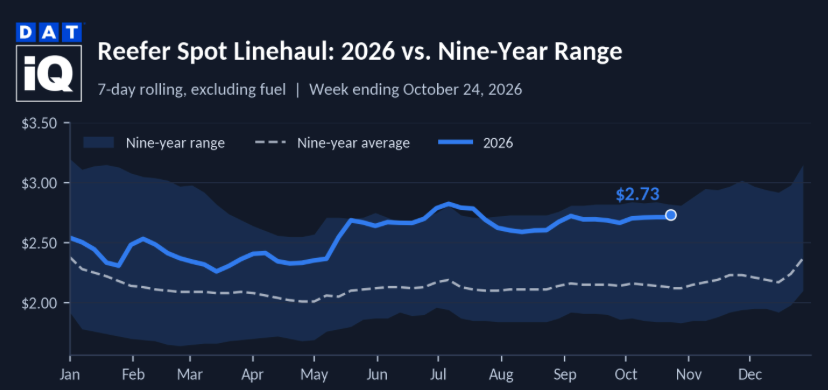
The refrigerated freight market had a bit of an identity crisis last week.
Produce shipments rebounded, but spot rates still managed to slide as load postings declined and truck availability improved slightly. Despite the cooling, rates remain well above historical averages, proving that even when the market takes a breather, refrigerated capacity isn’t suddenly going on clearance.
All rates exclude fuel.
The market’s mixed signals reflect a familiar balancing act between freight demand and available capacity.
While agricultural shipments are picking up, that momentum hasn’t translated into stronger overall spot market activity. Carriers are still enjoying considerably higher rates than this time last year, but the slight improvement in truck availability is giving shippers a little breathing room.
Not exactly a buyer’s market, but at least they’re allowed to look at the price tag again.
The Upper Midwest remained the nation’s priciest reefer market at $3.61 per mile, while the Lower Midwest recorded the steepest weekly decline, falling $0.17 to $3.16. None of the top 10 origin regions posted a rate increase, although the Southeast held steady.
Produce activity offered a few bright spots:
Looking ahead, DAT forecasts reefer spot rates to climb modestly to $2.78 per mile over the next 35 days, with a projected range of $2.70 to $2.86. Seasonal produce demand should provide some support, but the broader market remains sensitive to changes in freight volume and truck availability.
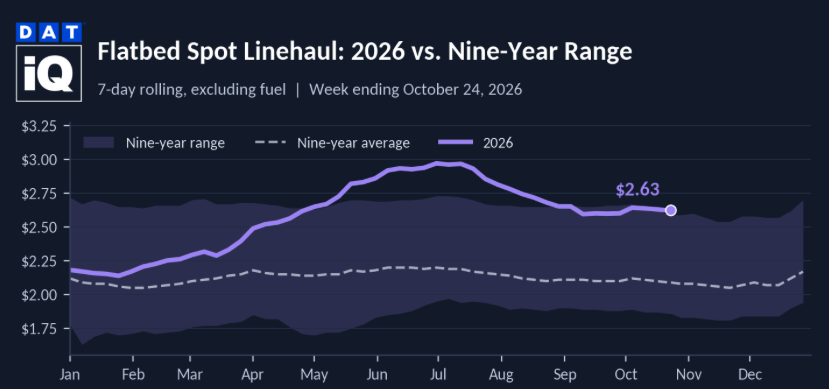
The flatbed market finally showed a little give last week, with more trucks hitting the boards and fewer loads competing for attention.
Spot rates slipped slightly as capacity improved, but don’t mistake that for a sudden market turnaround. Flatbed remains the tightest of the three major equipment types by a considerable margin. The market may have loosened its grip, but it’s still not particularly interested in sharing.
All rates exclude fuel.
Despite the slight improvement in available capacity, flatbed’s load-to-truck ratio remains roughly 3.7 times higher than dry van’s. That’s a pretty substantial gap, especially for shippers hoping to find some negotiating leverage.
The Upper Atlantic posted the strongest weekly gain, climbing $0.04 to $2.64 per mile, while the Lower Mountain and Florida-South Georgia regions each gained $0.01. Meanwhile, the Southeast took the biggest hit, dropping $0.10 to $2.97 per mile. The Ohio River region also softened, falling $0.09, although its $3.18 average remained among the highest in the country.
Looking ahead, DAT expects flatbed spot rates to ease toward $2.59 per mile over the next 35 days, with a projected range of $2.52 to $2.65. That’s the narrowest forecast range of the three major equipment types, suggesting a relatively stable market heading into November.

KCH is teaming up with Truck Parking Club to help drivers find safe, legal parking, without the scavenger hunt.
Use code KCH25 at checkout for $25 off your next reservation.
Less time circling the lot. More time doing literally anything else.

We’re now posting freight on the Trusted Freight Exchange (TFX), a secure, Highway-powered network made for verified carriers like you.
It’s built right into Highway, free to use, and designed to connect you with quality freight fast.
Every KCH load on TFX is:
With TFX, you skip the back-and-forth and get straight to hauling.
Designed for shippers who want straightforward market insight and smarter freight strategies.