


Good morning, and welcome to The Ship Show!
Something we launched into space during the Carter administration has officially traveled so far away that it takes an entire day just to tell it we miss it.
At 5:16 a.m. this morning, NASA’s Voyager 1 spacecraft officially reached a distance of one light-day from Earth, becoming the first human-made object to travel that far from home. That’s more than 16 billion miles.
For perspective, light travels approximately 186,000 miles per second, meaning even a radio signal traveling at the speed of light now takes 24 hours to reach Voyager.
If NASA sends it a message and gets an immediate response, that conversation takes two full days, kind of like me replying to a match on Hinge.
Voyager launched on September 5, 1977, and has spent the last 49 years traveling through space at roughly 38,000 mph.
To appreciate just how long that is, consider what Earth looked like when it left:
Strapped to Voyager is the Golden Record, a gold-plated phonograph record containing 115 images, greetings in 55 languages, and recordings of Earth’s greatest hits, including Beethoven, Chuck Berry, thunderstorms, birds, and whale noises.
The Golden Record is basically Earth’s dating profile. We picked our most flattering pictures, highlighted our interests, and conveniently left out everything that might scare away a potential match.
It’s worth mentioning that the Golden Record even includes a map showing aliens how to find Earth.
We literally sent our home address into space with a collection of our favorite songs. That’s an incredible amount of trust to place in a species we haven’t met.
And despite traveling for 49 years, Voyager isn’t particularly close to anything. It’ll take roughly another 40,000 years just to pass within 1.7 light-years of another star.
So there’s a decent chance humanity will be long gone before anyone discovers our little interstellar time capsule.
And if that day comes, some alien archaeologist will have to piece together the history of an extinct civilization using 115 pictures, a Beethoven symphony, and the sound of a humpback whale.
Honestly, I’ve seen documentaries built on less.
– Greyson Harris
In this week’s issue:

The Headlines
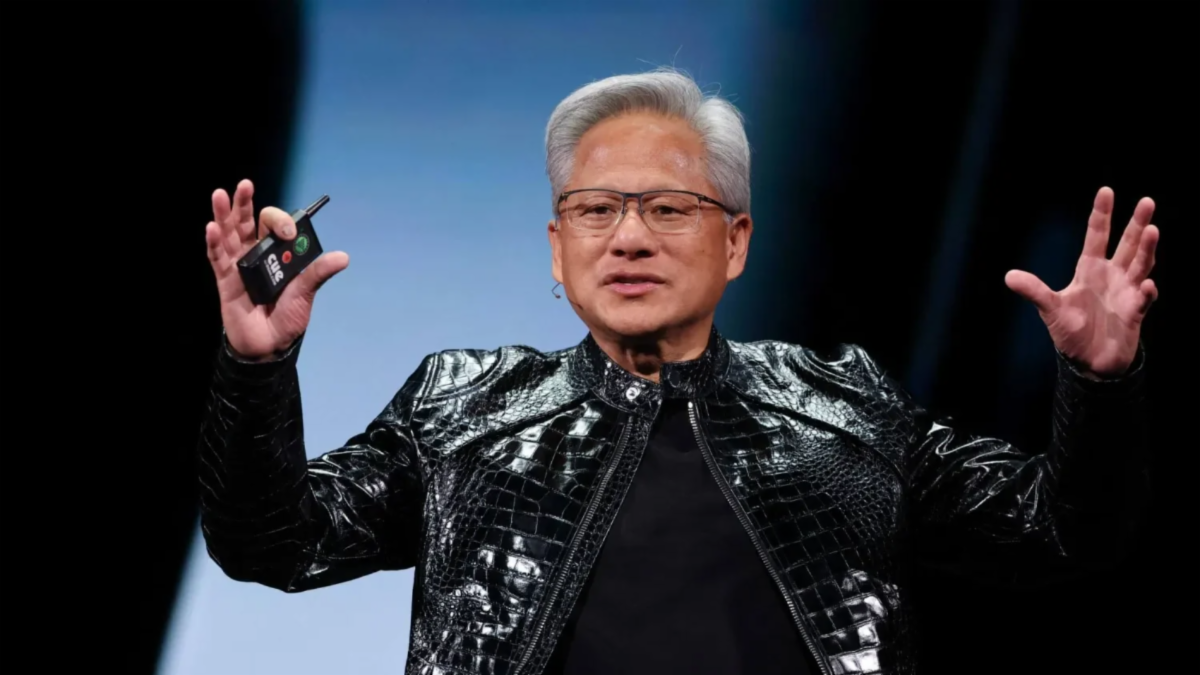
For years, Nvidia CEO Jensen Huang carefully cultivated his image as Silicon Valley’s coolest nerd. The leather jackets, the rock-star entrances, the adoring fans. He even had one of his used jackets sell for $960,000 at auction.
But then the 63-year-old billionaire got a little too good at being cool.
Huang resigned as CEO of Nvidia last week following revelations of multiple extramarital affairs, including one involving a woman U.S. intelligence officials suspect of spying for China.
That’s right. The guy responsible for powering the artificial intelligence revolution is now at the center of a scandal involving suspected international espionage, congressional investigations, and enough romantic complications to keep a reality television production crew employed for years.
And because Nvidia is one of the most important companies in the global economy, Huang’s personal life has somehow become everybody’s financial problem.
The trouble began in late October when The New York Times reported that Huang had developed a close relationship with Alice Huang, an executive at Singapore-based cloud computing company Megaspeed International.
And before you ask, no, the two Huangs are not related. Just an unfortunate coincidence that makes this story even harder to explain at Thanksgiving.
American intelligence officials suspect Alice Huang of having connections to Chinese intelligence. Her company was also under investigation for potentially helping Chinese businesses obtain restricted Nvidia chips.
China has denied the espionage allegations, and Nvidia has denied knowingly facilitating illegal chip shipments.
On November 8, Jensen admitted publicly that he’d been unfaithful to his wife and apologized to his family, employees, and shareholders.
Unfortunately, the story didn’t stop there.
Reporters subsequently uncovered allegations of an affair with Nvidia’s vice president of healthcare, Kimberly Powell, followed by reports of a relationship with another Nvidia employee.
Three reported affairs, one suspected foreign intelligence connection, and approximately zero reasons for the human resources department to enjoy coming to work.
By November 12, Huang had resigned from the company he co-founded 33 years earlier. Nvidia’s longtime CFO, Colette Kress, stepped in as interim CEO.
The man spent decades developing some of the world’s most advanced processors, only to discover that the most difficult thing to manage was his own roster.
The world’s most expensive adultery
Under normal circumstances, a billionaire’s infidelity scandal would be something for celebrity gossip sites and people who watch The Real Housewives religiously.
But Nvidia isn’t exactly a normal company.
Its processors power much of the modern AI industry, from ChatGPT to the enormous data centers being built by Microsoft, Amazon, Google, and others.
And Wall Street has become deeply dependent on the AI boom continuing.
The fallout has wiped more than $700 billion from Nvidia’s market value, raising concerns about what happens when the face of the world’s most important AI chip company suddenly disappears.
The supply chain implications are just as significant:
To be clear, the scandal hasn’t suddenly stopped semiconductors from moving around the world. But analysts worry Huang’s departure could disrupt supplier relationships, investment decisions, and an industry that has spent billions preparing for continued growth.
That’s a remarkable amount of economic uncertainty to generate by being bad at monogamy.
Questionable allies
Meanwhile, Silicon Valley has been handling the situation with its usual level of normalcy.
Elon Musk and other tech figures publicly supported Huang’s return. President Trump also backed the idea, suggesting the former CEO had learned his lesson.
There was even a “Stand with Jensen” petition, because getting caught in an international espionage-adjacent affair scandal is something you can overcome if enough billionaires sign your yearbook.
Huang eventually offered to return as CEO if Nvidia’s board wanted him back.
The board’s response during Tuesday’s earnings call was essentially: Appreciate it, but absolutely not. Chairman Harvey Jones said the directors had unanimously accepted Huang’s resignation and had no intention of reinstating him.
Meanwhile, Nvidia reported $115.8 billion in quarterly revenue on Tuesday, up 103% from a year earlier, and projected approximately $130 billion for the next quarter.
Its shares jumped in after-hours trading, suggesting the AI money machine is still running just fine without the man who built it.
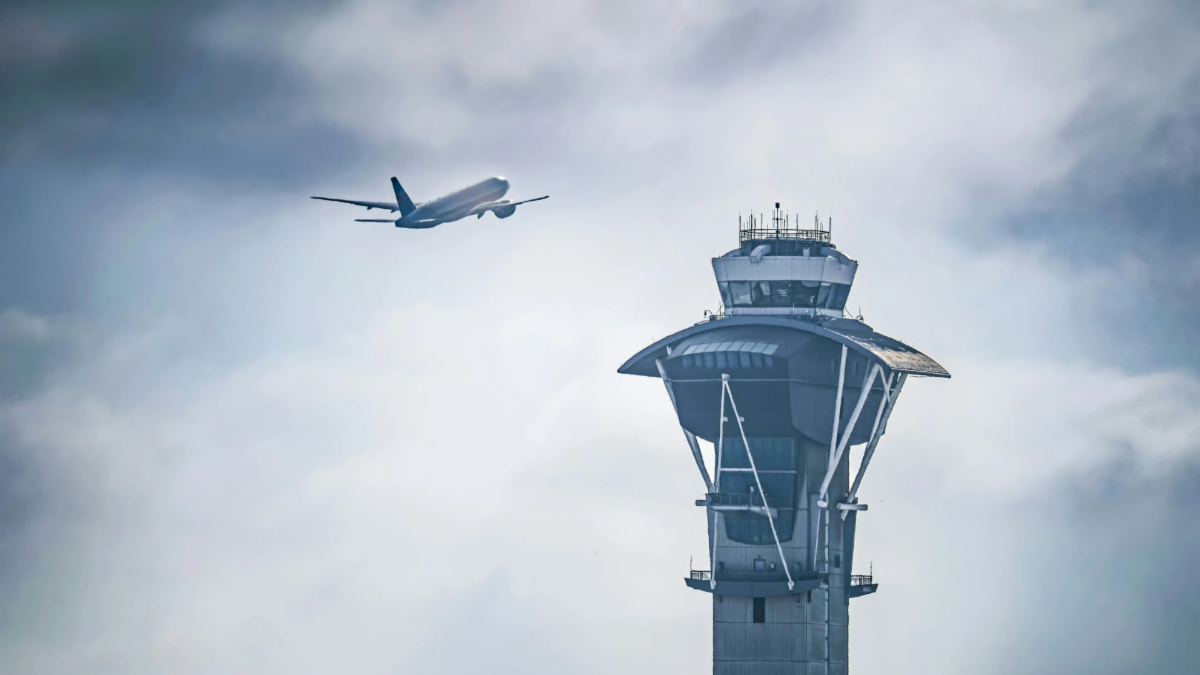
Friday the 13th lived up to its reputation last week when the Federal Aviation Administration decided everyone needed to stay home.
On November 13, the FAA issued a rare nationwide ground stop, halting nearly all departing flights across the United States for more than four hours because of a massive communications failure.
It was only the second nationwide ground stop since 9/11, following a similar technological disaster in January 2023.
No terrorist attack. No catastrophic weather event. No mysterious foreign hackers. Just an aging computer network that apparently couldn’t handle a software upgrade.
And because this is America, fixing that problem might require another $50 billion.
The trouble began around 3:30 p.m. ET when air traffic controllers started experiencing problems with radar information and communications across the country.
Within minutes, the FAA ordered nearly all departing aircraft to remain on the ground. The roughly 3,500 planes already airborne were allowed to land safely while officials scrambled to determine what had gone wrong.
By 8:15 p.m., the ground stop was lifted, but the damage was already done.
Here’s a look at the fallout:
And, as anyone who’s ever had a connecting flight canceled knows, getting planes flying again doesn’t magically solve the problem.
Planes were in the wrong cities. Pilots were in the wrong places. Flight crews were running out of legally permitted working hours.
Millions of Americans were once again reminded that the only thing worse than being stuck in an airport is being stuck in an airport with a $19 sandwich and no information.
Officials initially worried the disruption might have been a cyberattack, but investigators found no evidence of malicious activity.
The actual explanation was somehow more embarrassing.
According to Transportation Secretary Sean Duffy, government contractor L3Harris was performing routine maintenance at a remote FAA facility in El Dorado, Arkansas, replacing outdated communications equipment as part of a transition from copper wiring to fiber optics.
During that work, the network was flooded with approximately 1,000 connection attempts every four to five seconds, overwhelming the aging infrastructure and disrupting radar and radio communications.
In other words, a technology upgrade intended to make the system better helped bring the entire thing to its knees.
Investigators are still determining exactly why the failure happened, including whether the problem involved equipment, configuration, or installation.
For additional context, some of the older routers being replaced were manufactured in 2001 and were supposed to be retired in 2006, meaning the system coordinating thousands of aircraft traveling hundreds of miles per hour has been relying on equipment old enough to remember MySpace.
The disruption extended well beyond ordinary passengers trying to get home.
FedEx, UPS, and other air cargo operators faced interruptions that threatened delivery schedules, particularly for shipments relying on tight overnight connections.
The college football world also got dragged into the mess.
Auburn took buses to Mississippi State, Washington’s football team had to return to campus before eventually departing, and the Ole Miss-Oklahoma game was pushed from Saturday to Sunday.
Meanwhile, Homeland Security Secretary Markwayne Mullin, who helped explain the shutdown at Friday’s White House briefing, drew criticism after flying on a government aircraft to the LSU-Texas game the following day.
Mullin defended the trip, saying the airspace had already reopened and that he was required to use government transportation.
So at least one football fan’s travel arrangements worked out.
Perhaps the biggest takeaway is how vulnerable America’s aviation infrastructure remains.
Duffy is urging Congress to provide approximately $50 billion to modernize the nation’s air traffic control system, arguing that decades of inadequate investment have left the FAA dependent on obsolete equipment.
Congress previously approved $12.5 billion toward modernization, but officials say much more is needed to replace the underlying communications infrastructure.
Lawmakers are now demanding answers about how a problem at one relatively small facility could trigger a nationwide shutdown, particularly when the system is supposed to have safeguards against exactly this kind of failure.
The good news is that every aircraft landed safely, and commercial flight schedules were largely recovering by the beginning of the week.
The bad news is that investigators still haven’t established the root cause of the malfunction, and the FAA has thousands of equipment upgrades remaining.
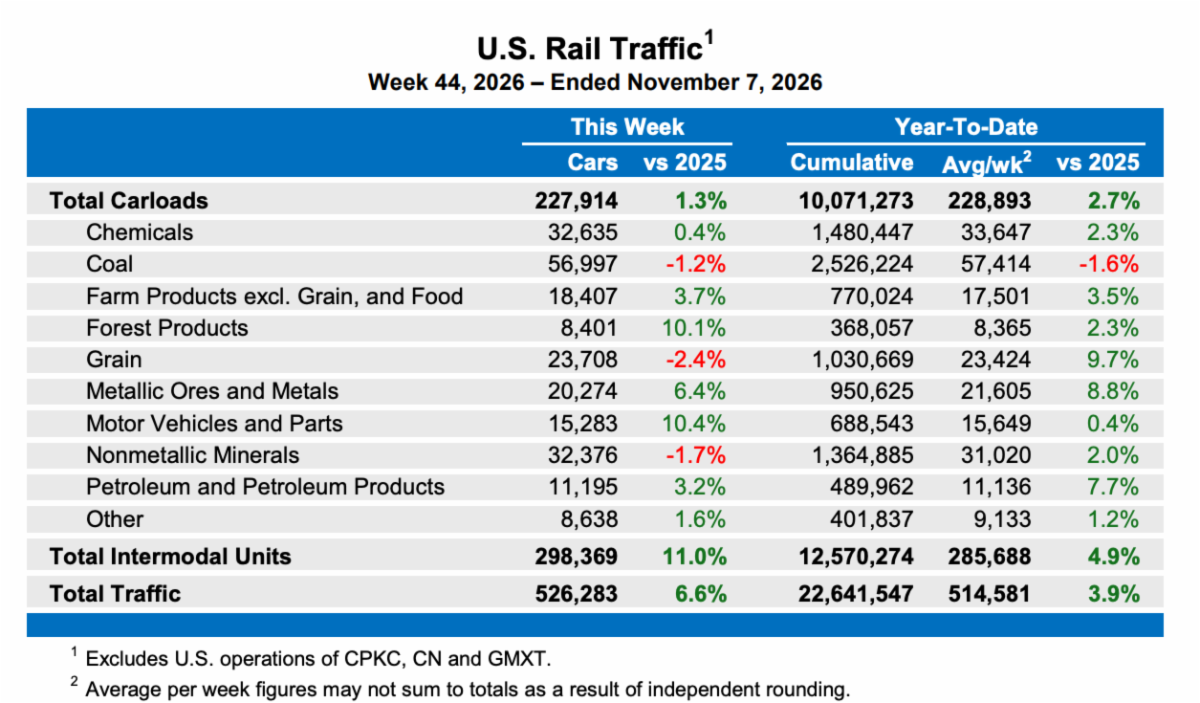
🚂 Intermodal drives another week of rail growth: U.S. rail traffic increased 6.6% year over year for the week ending November 7, fueled by an 11% jump in intermodal shipments, according to the Association of American Railroads. Carloads rose 1.3%, with motor vehicles and parts (+10.4%) and forest products (+10.1%) leading commodity gains. Through the first 44 weeks of 2026, total rail traffic is up 3.9%.
🚢 Port of Los Angeles breaks another cargo record: The Port of Los Angeles handled 1.03 million TEUs in October, its busiest October ever and the second consecutive month above 1 million containers for the first time in its history. Loaded imports surged 25% year over year, while exports declined 7%, pushing the port’s five-month total to nearly 5 million TEUs. Despite record volumes, rail congestion remains a concern, with nearly 40% of import containers waiting nine or more days for an on-dock train.
✈️ Airfreight rates hit 2026 high as holiday demand builds: Global air cargo rates climbed 6.6% week over week to their highest level of 2026, according to the Baltic Air Freight Index, putting prices 28.2% above last year. Outbound rates from Hong Kong and Shanghai rose 4.6% and 5.7%, respectively, while Frankfurt recorded a 9.9% jump. Despite falling jet fuel costs, tightening capacity and rising demand ahead of Black Friday, Thanksgiving, and Christmas continue to push rates higher as the holiday shipping season approaches its peak.
⛽️ Diesel drops below $6 for first time since September: The national average diesel price fell 19 cents to $5.937 per gallon, its largest weekly decline since June 22. The drop marks the first time diesel has dipped below $6 since September 8 and brings prices 59.2 cents below their September 22 record high of $6.529.

After five years without a new James Bond movie and approximately seven million casting rumors, we finally have our next 007.
Amazon MGM Studios announced Monday that Robert Pattinson will take over as James Bond, succeeding Daniel Craig and becoming the seventh actor to officially play the world’s most famous British spy.
Yes, the guy who played a glitter-covered vampire in Twilight is now licensed to kill.
And with Amazon now running the franchise, Bond’s next assignment might be his most dangerous yet: making Jeff Bezos even richer.
The man with the golden checkbook
Amazon’s road to owning James Bond has been almost as complicated as the plots of the movies themselves.
The company has poured billions into the franchise, and getting complete creative control wasn’t cheap:
For decades, the Broccoli family controlled nearly every creative decision involving Bond. Now Amazon is calling the shots, which means the company responsible for delivering your toilet paper in two days also controls the future of 007.
From Twilight with love
Pattinson isn’t exactly an unknown. He played Cedric Diggory in Harry Potter, Edward Cullen in Twilight, and Bruce Wayne in The Batman.
His résumé now includes a wizard, a vampire, a billionaire vigilante, and an international secret agent. The man is one Spider-Man audition away from completing Hollywood’s entire Halloween costume section.
Interestingly, Pattinson’s casting breaks from Bond tradition. Previous producers generally preferred lesser-known actors who wouldn’t overshadow the character.
Pattinson, meanwhile, has already anchored two massive franchises and spent much of his career convincing audiences he’s more than the guy who sparkled in the woods.
Behind the camera, the franchise is getting some serious talent, too. Dune director Denis Villeneuve will direct the next film, while Peaky Blinders creator Steven Knight is writing the screenplay.
Coming soon to Prime Video…
With Amazon controlling Bond’s future, the franchise could expand well beyond its traditional theatrical releases.
Spinoffs, prequels, and streaming series are all possibilities. After all, Disney has demonstrated that you can build an entire streaming platform around explaining what every minor character was doing before they appeared in a movie.
As for the next movie, production is expected to begin in 2027, with a potential release in 2028. That would create a seven-year gap since No Time to Die, the longest between official Bond films.


We’re now posting freight on the Trusted Freight Exchange (TFX), a secure, Highway-powered network made for verified carriers like you.
It’s built right into Highway, free to use, and designed to connect you with quality freight fast.
Every KCH load on TFX is:
With TFX, you skip the back-and-forth and get straight to hauling.

The U.S. has 23 million truck parking spots. You should be able to find one without feeling like you’re on a wild goose chase.
We’re teaming up with Truck Parking Club to make that happen.
Use code KCH25 for $25 off your next reservation.
Less wandering. More rest.
Designed for shippers who want straightforward market insight and smarter freight strategies.