


Good morning, and welcome to The Cargo Club!
I’d like to extend my condolences to employers, romantic partners, gym owners, and anyone else who expects regular human participation over the next several weeks.
After 13 years of waiting, Grand Theft Auto VI finally arrived yesterday, and I think society is about to experience a very strange period of adjustment.
Millions of grown adults who have spent the last decade building careers, maintaining relationships, and developing healthy routines are about to throw all of that out the window because Rockstar made a fictional version of Florida.
Productivity is going to crater. Significant others will be told “five more minutes” approximately 400 times.
People who were meal-prepping salmon and going to bed at 10 p.m. will suddenly be eating gas station taquitos at 3 in the morning while fleeing a police helicopter.
Don’t worry. I did manage to pull myself away long enough to put together this week’s freight news.
Please appreciate the sacrifice.
– Greyson Harris
The Headlines
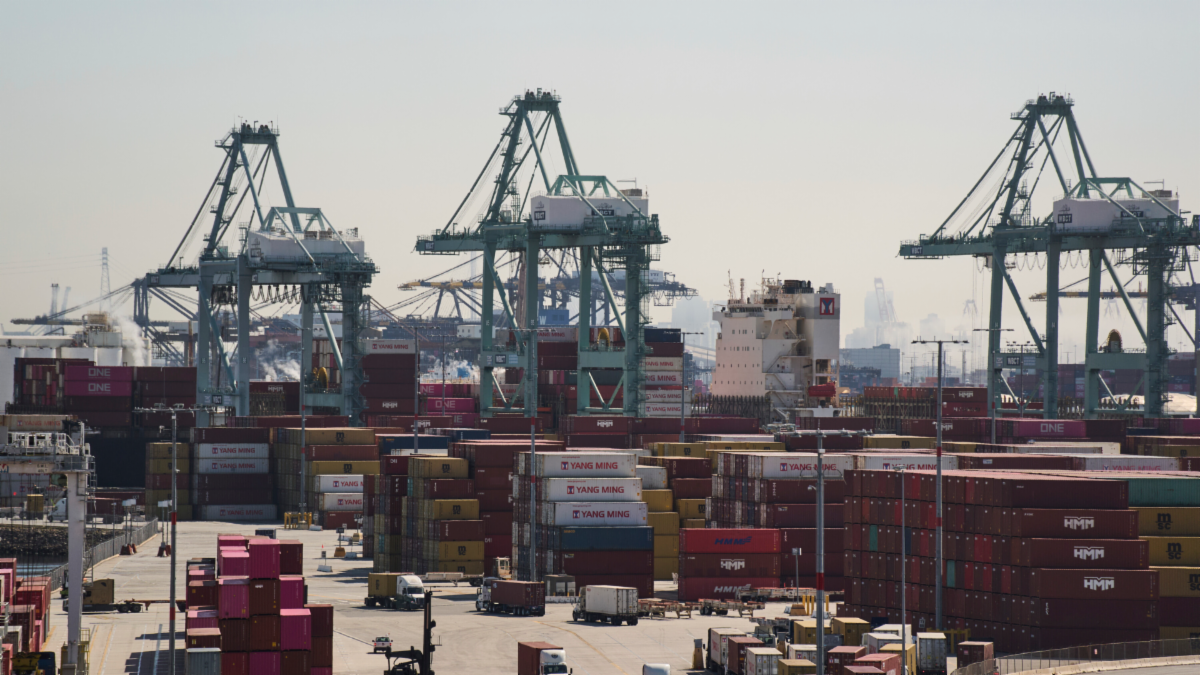
The ports of Los Angeles and Long Beach are staring down a potential strike, and the clock is officially ticking.
Contract negotiations between maritime employers and roughly 250 union security workers have stalled, leaving both sides with one final day to reach an agreement before a possible walkout Saturday morning.
The two sides are scheduled to meet again today, Friday, November 20. If they can’t reach a deal or agree to another extension, things could get ugly for the nation’s busiest port complex.
Small numbers, large impact
The dispute involves the International Longshore and Warehouse Union (ILWU) Local 26, which represents security watchmen responsible for checking credentials, patrolling terminals, and monitoring safety concerns.
While those 250 workers account for just 2% of the ports’ ILWU workforce, they happen to work at some pretty important locations.
According to the Pacific Maritime Association (PMA), the six terminals where these workers are stationed handle:
The bigger concern is that thousands of dockworkers, clerks, and foremen could honor the watchmen’s picket lines, effectively shutting down operations at several major terminals.
What’s the hold up?
Negotiations have been dragging on for more than a year, with the previous contract expiring in July 2025. Several extensions have kept workers on the job, but patience appears to be running thin.
The PMA says its latest offer includes:
Those figures come from the employers, who say the union has made little movement on its demands. Local 26 hasn’t publicly provided a detailed response to the latest proposal. Federal mediators have also been involved, but an agreement remains elusive.
The final countdown
The current contract extension expires at 12:01 a.m. Pacific on Saturday, November 21, leaving today’s negotiations as the last scheduled opportunity to avoid a strike.
If workers walk out and other ILWU members honor their picket lines, the disruption could spread well beyond the waterfront.
Truck drivers could be left waiting for freight, rail shipments could stall, warehouses could see reduced activity, and importers could face delays right as holiday shipping enters its final stretch.
The affected terminals supported an estimated $885 billion in national economic activity last year, according to an employer-cited analysis, so even a relatively short shutdown could carry serious consequences.
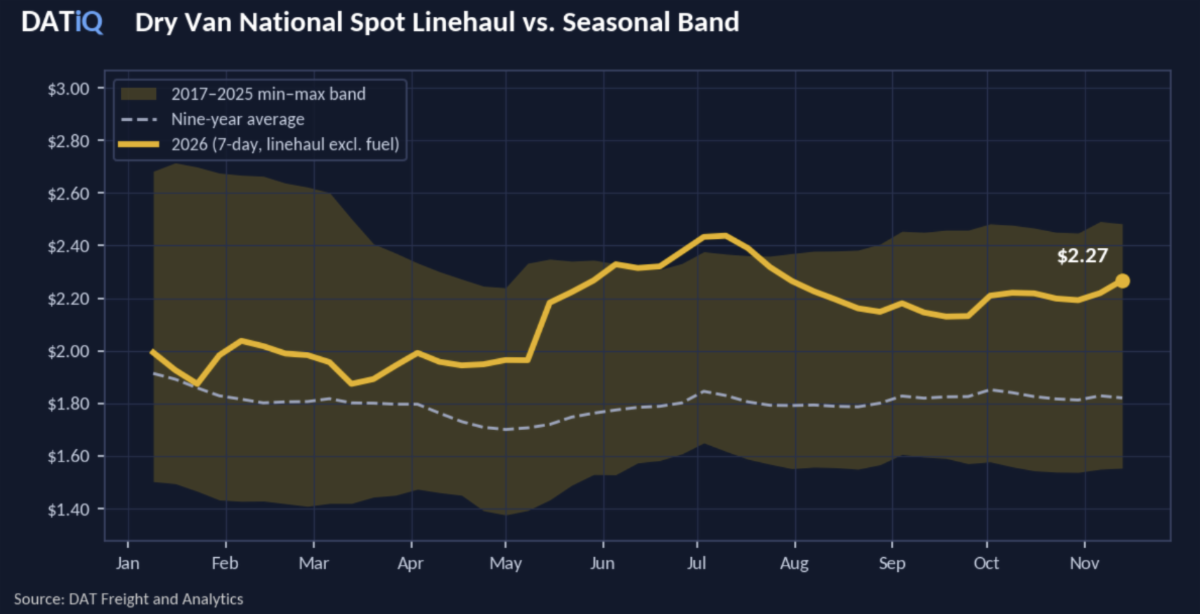
The dry van market is getting into the holiday spirit, and apparently that means higher rates.
Spot prices climbed again last week as Thanksgiving freight picked up, keeping carriers in a stronger position than they were a year ago. Capacity loosened slightly, but the market is still plenty tight heading into the busiest shipping stretch of the year.
According to DAT, here’s how the dry van market looked for the week ending November 13:
The load-to-truck ratio took a breather as fewer loads competed for more available trucks. Still, the year-over-year numbers tell a different story. Freight demand is stronger, available capacity is considerably thinner, and carriers have more pricing power than they did last November.
California continues to lead the country at $2.81 per mile, followed by the Great Lakes at $2.54. The South Central region posted the biggest weekly gain, adding $0.05 per mile, while the Southeast and Upper Atlantic each lost $0.03.
DAT expects national spot rates to reach $2.36 per mile over the next 35 days as holiday shipping ramps up and drivers begin positioning themselves closer to home for Christmas.
Thanksgiving is right around the corner, which means America’s annual effort to move millions of turkeys, pies, and questionable casseroles is officially underway.
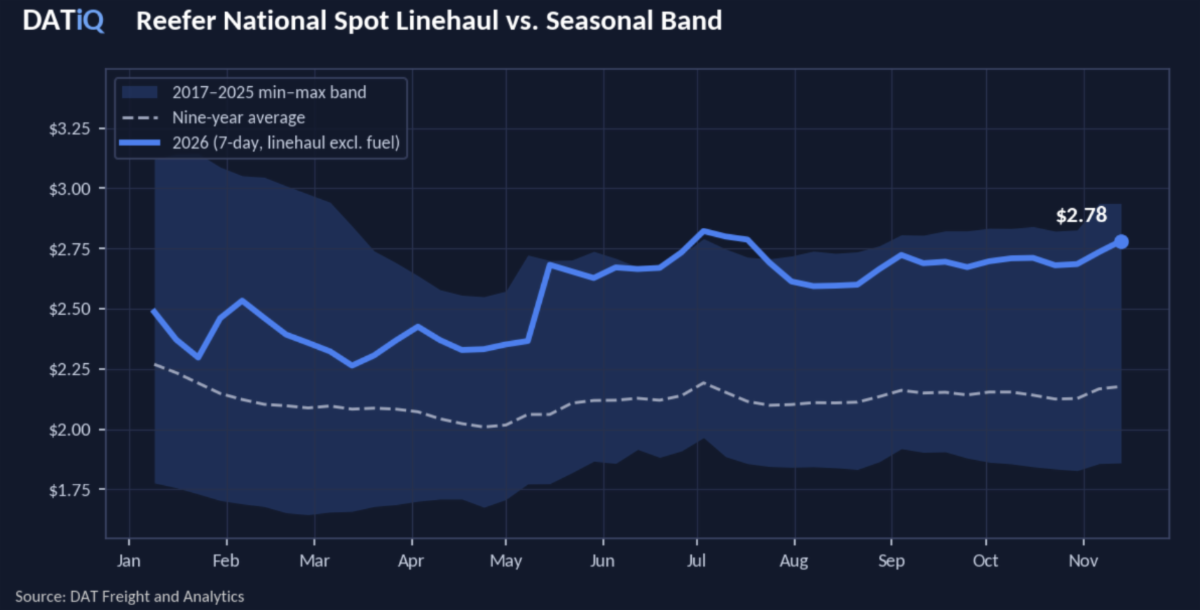
Reefer spot rates climbed again last week as holiday food shipments picked up. More trucks entered the market, easing some capacity pressure, but refrigerated freight remains considerably tighter than it was a year ago.
According to DAT, here’s how the reefer market looked for the week ending November 13:
The biggest change came from truck availability, which grew considerably faster than freight demand. That helped loosen the load-to-truck ratio, although carriers are still enjoying a much stronger market than last November.
Rates are also sitting near the top of their historical seasonal range, which means the holiday freight rush is doing its part to keep refrigerated capacity in demand.
The Upper Midwest led major regions at $3.62 per mile, followed by the Great Lakes at $3.29. The Lower Mountain region posted the biggest weekly gain, climbing $0.09 per mile, while the Ohio River region saw the sharpest decline, dropping $0.14.
DAT expects national reefer rates to hover around $2.79 per mile over the next 35 days, with forecasts ranging from $2.70 to $2.87.
While dry van and reefer carriers are enjoying a little holiday momentum, flatbed is apparently sitting this one out.
Spot rates barely budged last week as freight demand slowed and more trucks entered the market. Still, rates remain considerably stronger than a year ago, even as the construction and industrial sectors prepare for their annual winter slowdown.
According to DAT, here’s how the flatbed market looked for the week ending November 13:
Unlike the other equipment types, flatbed capacity loosened from both directions. Fewer loads hit the boards while more trucks became available, bringing the load-to-truck ratio down considerably.
Even so, rates remain near the top of their historical seasonal range. The market is also closely tracking 2021 levels, although the impressive year-over-year gains are partly thanks to a particularly weak 2025. Sometimes looking good is just a matter of standing next to someone having a worse year.
The Ohio River region led major markets at $3.13 per mile, followed by the Lower Atlantic at $2.93. California posted the biggest weekly gain, climbing $0.05 per mile, while Florida and southern Georgia recorded the steepest decline, dropping $0.10.
DAT expects national flatbed rates to reach $2.64 per mile over the next 35 days, with forecasts ranging from $2.57 to $2.70.

KCH is teaming up with Truck Parking Club to help drivers find safe, legal parking, without the scavenger hunt.
Use code KCH25 at checkout for $25 off your next reservation.
Less time circling the lot. More time doing literally anything else.

We’re now posting freight on the Trusted Freight Exchange (TFX), a secure, Highway-powered network made for verified carriers like you.
It’s built right into Highway, free to use, and designed to connect you with quality freight fast.
Every KCH load on TFX is:
With TFX, you skip the back-and-forth and get straight to hauling.
Designed for shippers who want straightforward market insight and smarter freight strategies.