


Good morning, and welcome to The Cargo Club!
Happy Friday the 13th, everyone.
Today is considered one of the unluckiest days of the year, as if Mondays weren’t doing enough damage on their own.
I’ve always found the concept of Friday the 13th fascinating. We live in a world with natural disasters, economic uncertainty, and people who leave their shopping carts in parking spaces, yet we’ve somehow convinced ourselves that a specific number appearing on a calendar is a legitimate cause for concern.
So naturally, I did some digging.
The superstition actually has some interesting roots. In Christian tradition, Friday was associated with Jesus’ crucifixion, while the number 13 was considered unlucky partly because there were 13 people at the Last Supper, including Judas, whose dinner etiquette left something to be desired.
For centuries, Fridays and the number 13 had separate reputations for bad luck, but the specific fear of Friday the 13th didn’t really become widespread until the 19th and 20th centuries.
In 1907, a stockbroker named Thomas Lawson even published a novel titled Friday, the Thirteenth, about a man who uses the superstition to manipulate Wall Street. Leave it to the financial industry to find a way to monetize an irrational fear.
Then, in 1980, Hollywood introduced Jason Voorhees into the equation, and suddenly the unluckiest thing about Friday the 13th was finding yourself at a summer camp with absolutely no adult supervision.
The superstition is now so widespread that some buildings still skip the 13th floor entirely. They’ll have a 12th floor, followed immediately by the 14th, as though renaming the floor somehow tricks whatever supernatural force is responsible for bad luck. Brilliant strategy.
Anyway, there’s no convincing evidence that Friday the 13th is any more dangerous than a regular Friday. So go about your business, pet a black cat, and enjoy your weekend.
If something terrible happens today, I’m inclined to blame your decision-making skills before the Gregorian calendar.
– Greyson Harris
The Headlines
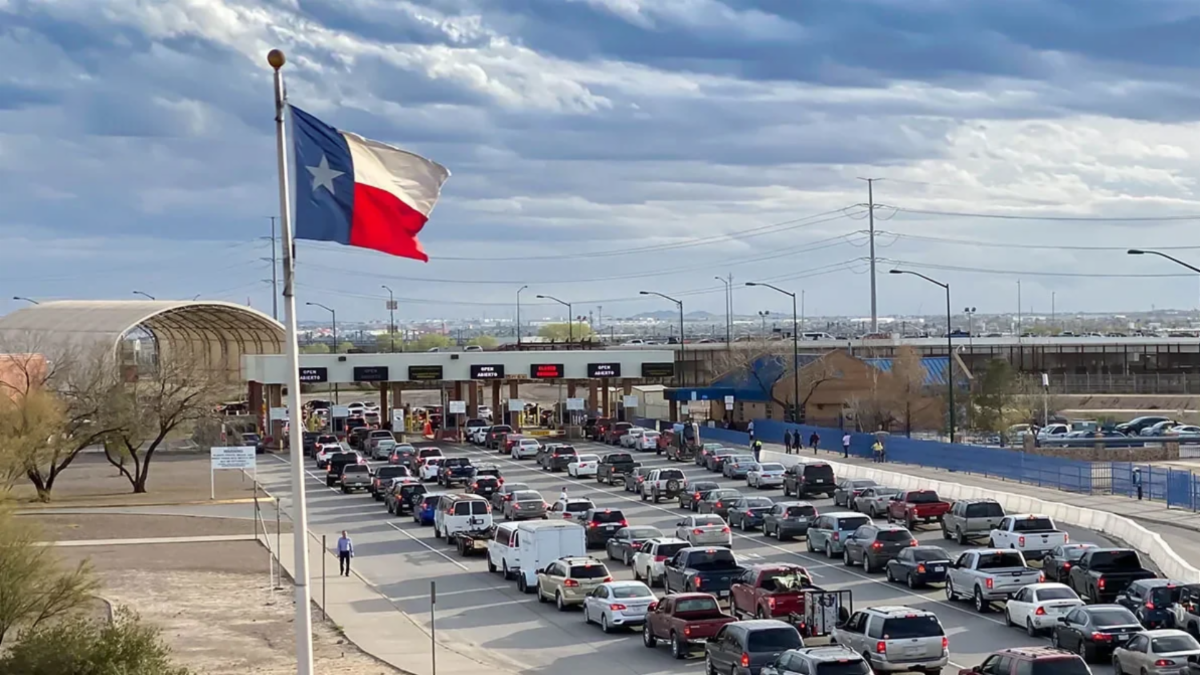
There’s a pretty important difference between driving freight into the United States and driving freight around the United States. For foreign truck drivers, that difference could determine whether they keep their visas.
Federal regulators are cracking down on foreign drivers hauling domestic freight, a practice that’s technically been illegal for decades.
The rules aren’t new, but enforcement has ramped up considerably in 2026, putting thousands of drivers and the carriers employing them under the microscope.
Get a B-1 visa B-4 you try to haul internationally
A B-1 classification permits foreign drivers to move freight connected to international trade. Basically, the cargo needs to be entering or leaving the country.
Here’s what drivers can legally do:
What they cannot do is haul domestic freight between two U.S. locations without separate work authorization.
That practice is called “cabotage” (not to be confused with sabotaged cabbages), and it’s where things get complicated.
Rules of engagement
Let’s bring this down in simple terms:
That last scenario is considered cabotage, which is the transportation of domestic freight by a foreign operator.
Essentially, a B-1 visa gives drivers permission to participate in international commerce, not an all-access pass to America’s trucking market.
Making a list and checking it twice
The federal government has stepped up enforcement throughout 2026, particularly along the southern border.
Transportation Secretary Sean Duffy has cited approximately 3,200 visa revocations tied specifically to cabotage since January, although the DOT has not independently confirmed that exact figure.
The crackdown is part of a broader effort targeting foreign driver qualifications, including English-language proficiency requirements and immigration compliance.
Federal agencies are sharing information, and drivers suspected of violations risk having their visas revoked at border crossings.
Enforcement has even reached Canadian operators. In August, Border Patrol arrested a Canadian driver accused of illegally hauling domestic freight between two New Mexico cities.
For American carriers, stricter enforcement could help level the playing field against operators using lower-cost foreign drivers for domestic freight they aren’t authorized to haul.
For brokers and shippers, the concern is reliability. A cheap truck isn’t much of a bargain if its driver loses authorization at the border and the shipment goes nowhere.
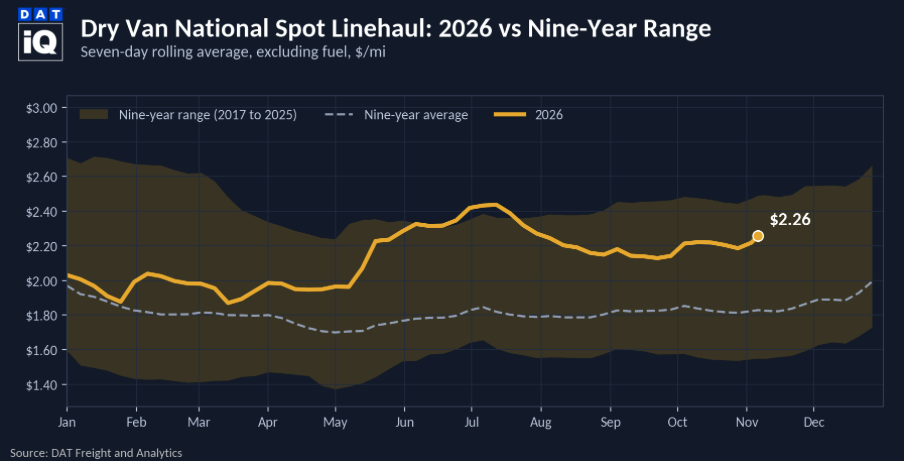
Dry van spot rates continued their upward climb last week, even as freight activity cooled slightly. Available truck capacity remains tight, giving carriers more negotiating power heading into the holiday shipping season.
With fewer trucks competing for loads, rates are holding well above typical seasonal levels.
According to DAT, for the week ending November 6:
The bigger story remains capacity. Even with fewer loads hitting the board, the shortage of available trucks is keeping rates elevated.
Meanwhile, the gap between spot and contract pricing continues to narrow, suggesting carriers are gaining leverage after a prolonged stretch of softer market conditions.
California led regional rate increases, climbing $0.15 to $2.77 per mile. The Great Lakes held relatively steady at $2.52, while the Lower Atlantic saw the largest decline, slipping $0.04 to $2.11.
Looking ahead, DAT forecasts national spot linehaul rates could reach $2.32 per mile over the next 35 days. Thanksgiving retail restocking should provide additional freight demand through late November, potentially pushing rates higher as shippers compete for limited capacity.
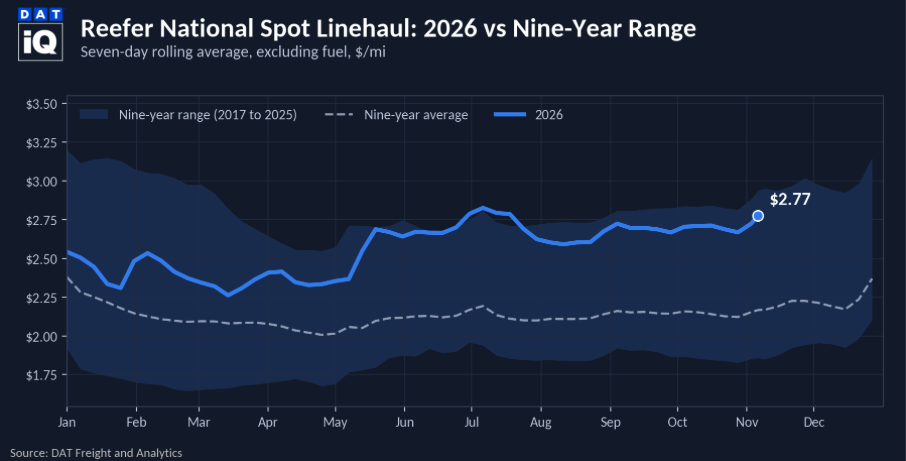
Refrigerated freight is heating up as the holiday shipping season gets underway. With Thanksgiving food shipments picking up and available truck capacity shrinking, reefer spot rates climbed again last week.
Carriers are gaining leverage as shippers compete to move everything from frozen turkeys to fresh produce ahead of the holiday rush.
According to DAT, for the week ending November 6:
The combination of rising freight demand and fewer available trucks is tightening the refrigerated market. Spot and contract rates are also nearly identical, with October’s spread narrowing to just $0.02 per mile compared to $0.29 a year earlier. That’s another sign of growing carrier leverage.
California and the Pacific Northwest led regional rate increases, each gaining $0.15 per mile, while the Upper Atlantic fell $0.08. The Upper Midwest remained among the most expensive regions at $3.56 per mile.
Looking ahead, DAT projects reefer spot rates will hold near $2.76 per mile over the next 35 days. Thanksgiving food shipments and Christmas tree season should keep refrigerated capacity busy through late November, particularly as grocery distributors rush to stock shelves before the holidays.
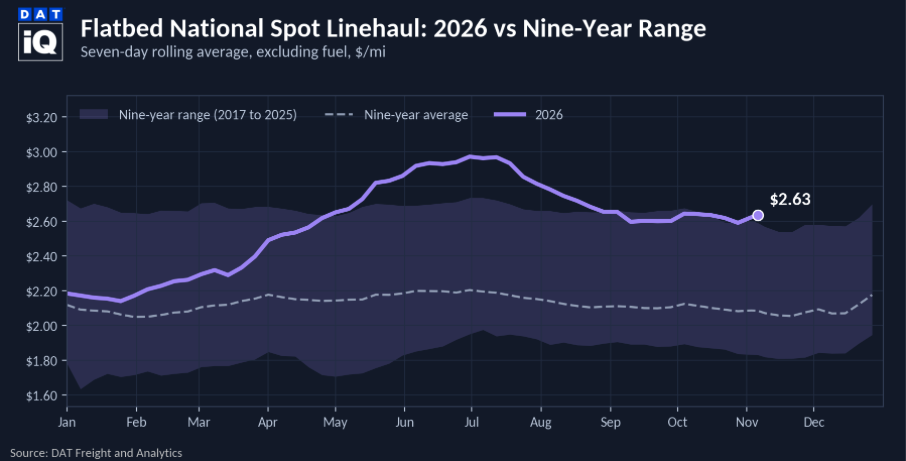
Flatbed spot rates continued their gradual climb last week, supported by stronger freight demand and a market that remains considerably tighter than a year ago. While load and truck availability both increased, freight volumes grew slightly faster, keeping pressure on capacity.
Rates are also running well above typical seasonal levels, even as the industry approaches its usual year-end slowdown.
According to DAT, for the week ending November 6:
Flatbed remains the tightest of the three major equipment markets, although contract rates still hold a significant advantage over spot pricing. The October spread stood at $0.43 per mile, considerably wider than dry van or reefer. Unlike those markets, flatbed spot rates have yet to overtake contract rates this year.
Houston flatbed lanes saw higher rates in every direction, although Lubbock was the only destination also recording increased load volumes. Regionally, the Upper Atlantic and Lower Mountain led rate gains, each climbing $0.06 per mile, while the Ohio River region fell $0.14 to $3.10.
Looking ahead, DAT forecasts flatbed spot rates will reach approximately $2.64 per mile over the next 35 days. Construction and industrial freight typically slow as the holidays approach, suggesting rates may level off through the remainder of the year. Even so, the market remains considerably stronger than it was heading into last winter.

KCH is teaming up with Truck Parking Club to help drivers find safe, legal parking, without the scavenger hunt.
Use code KCH25 at checkout for $25 off your next reservation.
Less time circling the lot. More time doing literally anything else.

We’re now posting freight on the Trusted Freight Exchange (TFX), a secure, Highway-powered network made for verified carriers like you.
It’s built right into Highway, free to use, and designed to connect you with quality freight fast.
Every KCH load on TFX is:
With TFX, you skip the back-and-forth and get straight to hauling.
Designed for shippers who want straightforward market insight and smarter freight strategies.