


Good morning, and welcome to The Ship Show!
Collins Dictionary just announced its 2026 Word of the Year, and the winner is “mogging.”
For those of us who don’t spend six hours a day on TikTok, mogging means outshining or outperforming someone, usually to the point of making them look inferior by comparison.
For example, if you show up to the office with a gas station breakfast burrito and your coworker walks in with homemade eggs Benedict, you’ve been breakfast-mogged.
If you subscribe to any other freight newsletter and then open The Ship Show on Wednesday morning, congratulations, you’ve just witnessed a newsletter get mogged.
You get the idea.
The word traces its origins to “AMOG,” an acronym for “Alpha Male of the Group,” which circulated through bodybuilding communities in the 2010s before eventually breaking contain and escaping into the general population.
Collins reports that usage of “mogging” increased 210% this year, which means a staggering number of people have decided that simply saying “outperformed” is no longer sufficient.
Other words that made the dictionary’s shortlist include:
I do appreciate that language evolves. It’s what keeps English interesting.
But there’s something deeply funny about a room full of professional linguists studying the vocabulary of teenagers who communicate primarily through memes and 15-second videos.
Anyway, I’m going to spend the rest of my morning newslettermaxxing in hopes of mogging every other freight publication in existence.
I don’t particularly enjoy that sentence either, but this is where we are as a society.
– Greyson Harris
In this week’s issue:

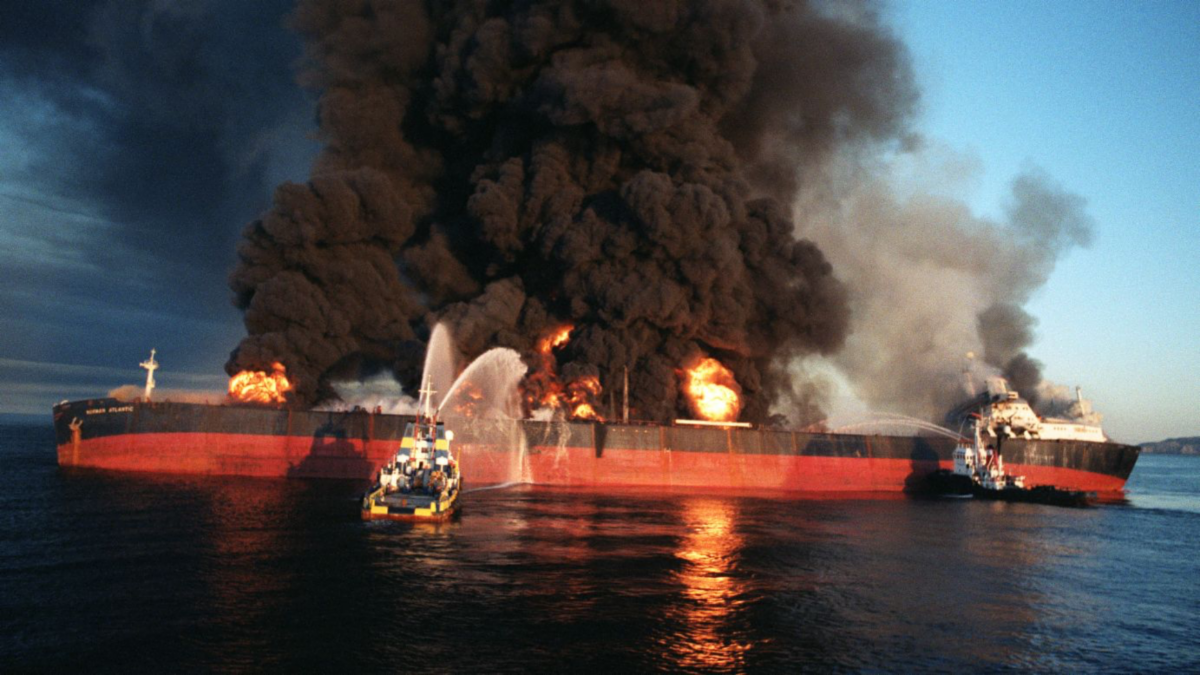
The Strait of Hormuz is technically open for business, provided you’re comfortable with the occasional missile, astronomical insurance premiums, and the possibility of your oil tanker becoming an international incident.
The U.S. blockade has nearly eliminated Iran’s oil exports, while Tehran continues launching sporadic attacks on commercial vessels passing through the waterway.
At this point, the only guaranteed winner appears to be whoever is selling maritime insurance.
The U.S. and Iran have spent the past eight months inflicting considerable economic damage on one another, with neither side showing much interest in blinking first.
The American blockade has effectively strangled Iran’s oil exports, reducing the roughly 2 million barrels per day it shipped before the war to a tiny fraction moving overland. That’s a substantial blow to an economy worth approximately $300 billion and a major source of funding for Tehran’s military.
Iran, meanwhile, is retaliating by making one of the world’s most important shipping corridors an increasingly expensive place to conduct business.
Even though U.S. Central Command says roughly 95% of ships pass through Hormuz without incident, the threat of an attack has driven up insurance premiums and tanker rates.
At one point in early October, chartering a supertanker in certain markets was more expensive than launching a rocket into space.
That’s right. Leaving the planet is more economically sound than traversing the Strait of Hormuz.
An explosive situation
October brought at least 28 reports of shipping damage in the strait, with several attacks deliberately targeting vessels’ engine rooms.
The International Maritime Organization has recorded more than 120 incidents across Hormuz and the surrounding region since the war began, including 24 confirmed seafarer fatalities.
Military analysts say Tehran stockpiled enough missile components to maintain intermittent attacks even after losing much of its production capacity.
And because its ability to track distant targets has been severely degraded, some weapons are launched toward general shipping areas rather than specific vessels.
It’s not a particularly sophisticated strategy, but it doesn’t have to be. Every attack forces shipping companies to reassess the risks, insurers to adjust premiums, and military forces to spend money protecting commercial traffic.
The price of doing business
Despite everything, tanker operators are still lining up to make the trip.
The reason is fairly straightforward: money.
Some supertanker owners are earning tens of millions of dollars for voyages through the strait, while crew members can receive several months’ worth of pay for just a few days of dangerous navigation.
It’s an extraordinary financial incentive, although most jobs offering that kind of hazard pay also involve considerably less naval warfare.
Meanwhile, the U.S. faces its own economic consequences. Elevated oil prices continue putting pressure on American consumers, and analysts warn another major escalation could push crude toward $120 to $130 per barrel.
President Trump has suggested additional military strikes against Iran, although experts caution that another round of bombing may do little to eliminate Tehran’s remaining ability to threaten shipping.
For now, both countries appear stuck in a conflict where neither can easily force the other to surrender, and neither can afford to ignore the economic consequences.
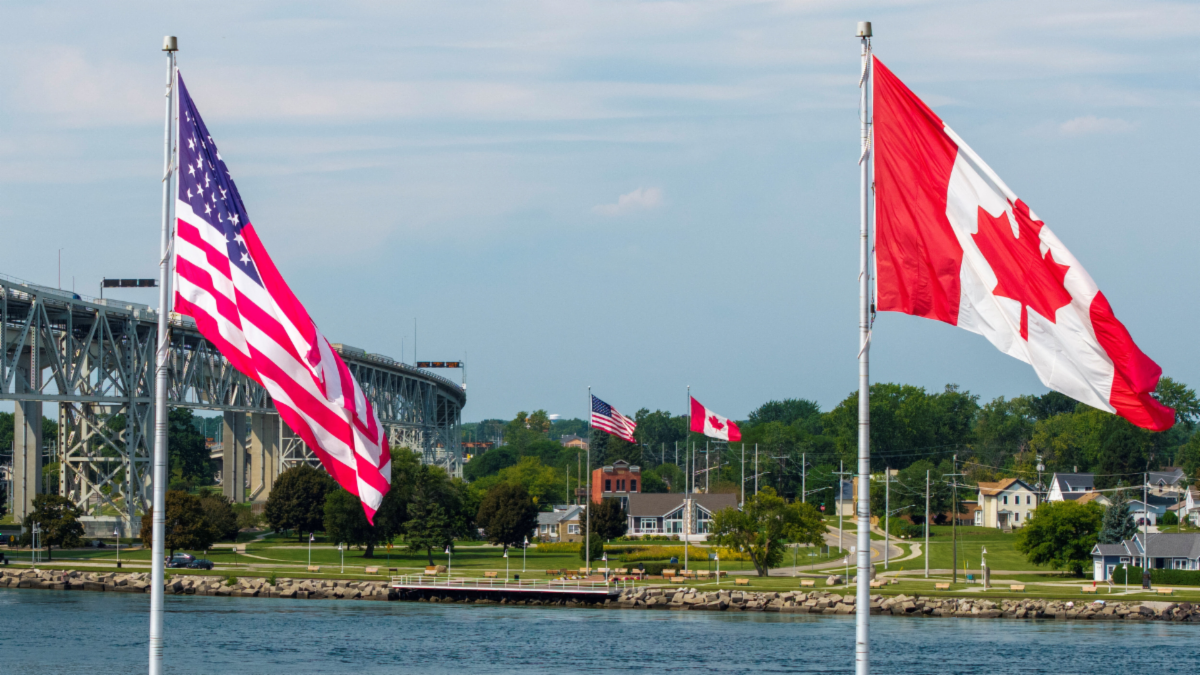
After months of tariffs, threats, and the occasional suggestion that Canada should become America’s 51st state, Washington and Ottawa are apparently getting along again.
Canadian Prime Minister Mark Carney and President Donald Trump reported progress toward a new trade agreement over the weekend, with both leaders suggesting a deal could be within reach.
It’s a welcome change from August, when negotiations collapsed and the two countries responded by taxing each other’s products into oblivion.
Of course, getting along and actually signing an agreement are two very different things.
A taxing relationship
Relations between the neighboring countries took a particularly ugly turn in August when Canada walked away from negotiations over U.S. demands that Carney argued threatened Canadian sovereignty, French-language protections, and the country’s automotive industry.
Trump responded by imposing 50% tariffs on roughly $20 billion in Canadian goods, prompting Canada to retaliate with its own duties.
The dispute created headaches for manufacturers, farmers, and businesses operating across one of the world’s busiest trading relationships.
Now, the tone appears to be changing.
Following a conversation with Carney over the weekend, Trump announced that the countries had the “concept” of a very good deal.
Not an actual deal, mind you. Just the concept of one.
Carney was similarly optimistic, announcing that negotiators would spend the coming weeks working toward an agreement. By Tuesday, he said discussions had intensified and Washington was “asking less and offering more,” which is the cornerstone for every successful relationship, business or otherwise.
Let’s talk
While the details remain unresolved, several major issues are reportedly under discussion:
That last development is particularly significant. Those demands helped derail negotiations in August, and Carney has made clear that Canada’s sovereignty isn’t something he’s willing to negotiate away.
Still, he acknowledged Tuesday that important disagreements remain, without specifying exactly what they are.
Forgive, but don’t forget
Even with negotiations improving, Canada isn’t particularly eager to find itself in this position again.
Carney has been working to reduce the country’s economic dependence on the U.S., including pursuing closer ties with the European Union. On October 30, Canada and the EU announced a new partnership, with Ottawa seeking to become the bloc’s first associate member.
Carney has also set a goal of doubling Canadian exports to markets outside the U.S. over the next decade.
Essentially, Canada would like to keep its biggest customer while making sure it has a few others to call when things get complicated.
For North American shippers, a potential agreement could bring some much-needed predictability to cross-border trade, particularly for industries dealing with elevated tariffs and uncertain supply chains.
But nothing has been finalized, and the two countries still have plenty to negotiate.
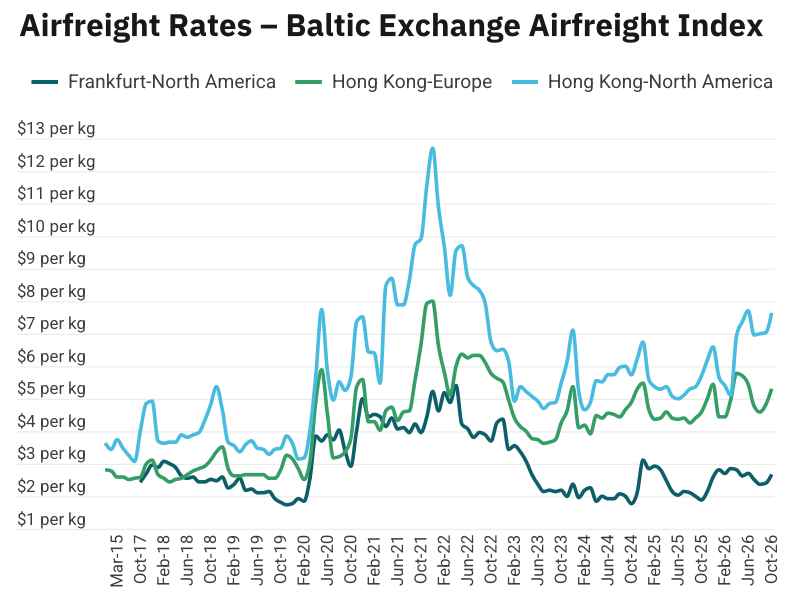
✈️ Transpacific airfreight rates surge: Air cargo rates from Hong Kong to North America climbed from $7.16 per kg at the beginning of October to $8.17 by month’s end, finishing 38.7% above year-ago levels, according to TAC Index. The monthly average reached $7.64 per kg, up 34% year over year, while Hong Kong-to-Europe rates averaged $5.31 per kg, a 15.7% increase. Strong demand for AI and data center equipment, rising peak-season volumes, and jet fuel prices up 118.5% year over year are driving the increases, with further rate pressure expected through the holiday shipping season.
🚢 U.S. ocean freight rates show mixed signals: The NYSHEX Freight Index reported a 1.9% increase in Asia-to-U.S. West Coast rates to $7,725 per 40-foot container, while East Coast rates rose 1.9% to $10,125. However, Drewry’s World Container Index showed the opposite trend, with Shanghai-to-Los Angeles rates falling 6% to $7,514 and Shanghai-to-New York dropping 5% to $9,631. Import demand is projected to decline 11% in November, which could put additional downward pressure on rates.
🚂 U.S. rail traffic gains momentum: U.S. railroads moved 538,503 carloads and intermodal units during the week ending October 24, up 7.8% year over year, according to the Association of American Railroads. Intermodal shipments led the growth, rising 11.3%, while traditional carloads increased 3.6%. Eight of the 10 major commodity groups posted gains, led by petroleum products (+15.4%) and motor vehicles and parts (+15.3%). Year-to-date rail traffic is up 3.8%.
⛽️ Diesel prices retreat: The national average for on-highway diesel fell 6 cents to $6.292 per gallon this week, ending two consecutive weeks of increases. Prices declined across every region, with California remaining the most expensive at $8.076 per gallon, while the Gulf Coast averaged $5.912. Despite the weekly relief, diesel remains $2.539 per gallon higher than a year ago.

In November 1998, 29-year-old Karl Bushby left his home in Hull, England, with a fairly ambitious plan: walk around the entire world without using transportation to advance his journey.
On Monday, November 2, he finally returned to his mother’s house in Hull, England, completing a journey that took him across four continents, 30 countries, and nearly three decades.
Along the way, he survived polar bears, dangerous jungles, freezing oceans, and enough immigration paperwork to qualify for a second career in customs enforcement.
Walk it out
The idea began in the mid-1990s when Bushby’s father mentioned a debate among soldiers about whether someone could theoretically walk from London to New York by crossing the frozen Bering Strait.
Bushby took that hypothetical and turned it into a 28-year commitment.
On November 1, 1998, he departed from Punta Arenas, Chile, with $500 and two rules:
He initially estimated the expedition, which he named the Goliath Expedition, would take around 12 years. That turned out to be a fairly optimistic assessment.
Over the following decades, Bushby encountered just about every obstacle the planet could reasonably throw at one person:
That last detail deserves some attention. 31 days of floating in the open sea. Voluntarily.
And you thought your commute was tough
For all the dangerous terrain, wild animals, and near-death experiences, Bushby’s biggest obstacle was often getting permission to enter the next country.
His progress through Russia was repeatedly interrupted by visa restrictions, forcing him to spend months or even years waiting to continue. In 2012, after being denied another visa, he walked from Los Angeles to the Russian Embassy in Washington, D.C., to protest.
The 2008 financial crisis disrupted his sponsorship funding, COVID-19 created additional delays, and geopolitical tensions eventually forced him to swim across the Caspian Sea rather than travel through Russia or Iran.
By the time Bushby reached Europe, the expedition had consumed nearly half his life.
Momma, I’m coming home
On Monday, Bushby received a hero’s welcome as hundreds gathered in Hull to celebrate his return.
He eventually made his way to his mother’s house, where Angela Bushby, whom he hadn’t seen in 10 years, greeted him with an emotional embrace and the entirely justified question, “Where have you been?”
Bushby also reunited with his 36-year-old son and met his 12-year-old granddaughter for the first time.
After spending nearly half his life dedicated to a single mission, Bushby admits he’s struggling with the prospect of returning to ordinary society. He has speaking engagements scheduled, another book planned, and a documentary being produced by filmmaker Werner Herzog.
For now, he’ll be moving into his mother’s basement while he figures things out.
Twenty-eight years, 31,000 miles, multiple near-death experiences, and a trip across the entire planet, only to wind up living with your mom.
The housing market really is brutal everywhere.


We’re now posting freight on the Trusted Freight Exchange (TFX), a secure, Highway-powered network made for verified carriers like you.
It’s built right into Highway, free to use, and designed to connect you with quality freight fast.
Every KCH load on TFX is:
With TFX, you skip the back-and-forth and get straight to hauling.

The U.S. has 23 million truck parking spots. You should be able to find one without feeling like you’re on a wild goose chase.
We’re teaming up with Truck Parking Club to make that happen.
Use code KCH25 for $25 off your next reservation.
Less wandering. More rest.
Designed for shippers who want straightforward market insight and smarter freight strategies.