


Good morning, and welcome to The Cargo Club!
Today marks the 25th anniversary of the original iPod, which Apple unveiled on October 23, 2001, with the revolutionary promise of putting 1,000 songs in your pocket.
For those who don’t remember, this was an enormous deal. Before Spotify and Apple Music gave us unlimited access to virtually every song ever recorded, we had to actually work to listen to music.
And what exactly were people listening to back in 2001? Glad you asked.
Here’s a little sample of what was dominating the charts:
An absolutely spectacular time to be alive.
– Greyson Harris
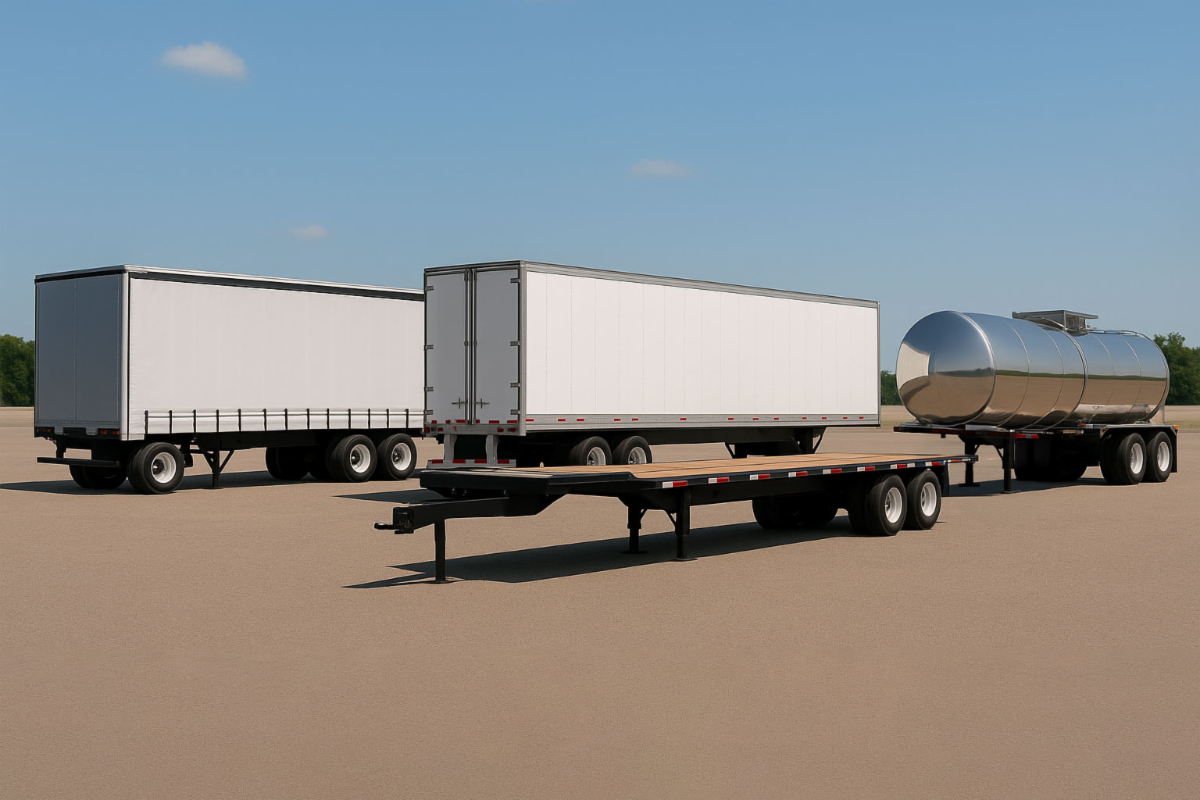
The trucking industry appears to be suffering from a rather specific case of retail therapy.
U.S. trailer orders skyrocketed in September, posting their strongest month in nearly four years. Meanwhile, demand for the actual trucks needed to pull those trailers remains a little less enthusiastic.
It’s an unusual split that suggests fleets are preparing for the future, even if nobody’s particularly confident about what that future looks like.
According to FTR Transportation Intelligence, U.S. trailer orders reached 43,059 units in September, a 78% increase from August and a staggering 385% jump from the same month last year.
That’s the strongest monthly performance since December 2022. ACT Research reported similarly impressive figures, estimating 42,700 orders, up 311% year over year.
Before anyone starts planning a parade for the freight market’s triumphant return, there’s some context worth considering.
Trailer purchases have been unusually weak in recent years, leaving fleets with aging equipment and plenty of overdue replacements. The opening of 2027 order books also arrived earlier than usual, while fears of tariff-related price increases encouraged buyers to act sooner rather than later.
Essentially, fleets are replacing old equipment while trying to get ahead of future costs. Whether that translates into stronger freight demand is another question entirely.
Class 8 truck orders told a considerably less exciting story, although exactly how disappointing depends on who’s counting:
The disagreement between the two research firms isn’t exactly helping an industry already swimming in uncertainty.
Much of that uncertainty centers on the EPA’s 2027 emissions requirements and the potential cost of new trucks. Fleets are weighing expensive equipment purchases against the possibility of regulatory changes, additional tariffs, and higher manufacturing costs.
Buying a new truck is already a major financial commitment. Buying one without knowing what the rules or price tags will look like next year is an entirely different headache.
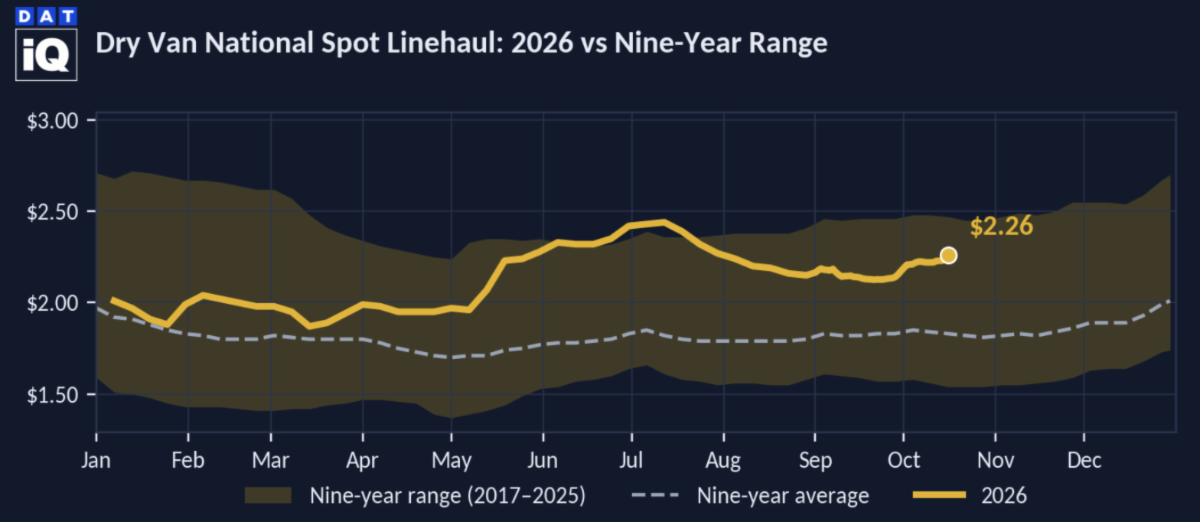
The dry van spot market remained relatively stable last week as declining load postings were largely offset by limited truck availability. Despite softer freight activity, rates continue to hold well above historical averages, reflecting a market where capacity remains tight.
Although freight demand softened, the continued shortage of available trucks is helping prevent significant rate declines. With capacity considerably tighter than a year ago, carriers retain some pricing leverage even as seasonal shipping activity cools.
California was the only major region to record a weekly rate increase, climbing $0.04 to $2.56 per mile. The Lower Midwest remained unchanged, while the Carolinas experienced the sharpest decline, falling $0.06 per mile.
Looking ahead, DAT forecasts national dry van spot linehaul rates will ease slightly to $2.23 per mile over the next 35 days. While modest declines are expected, the market remains substantially stronger than last fall, suggesting limited capacity could continue supporting rates heading into November.
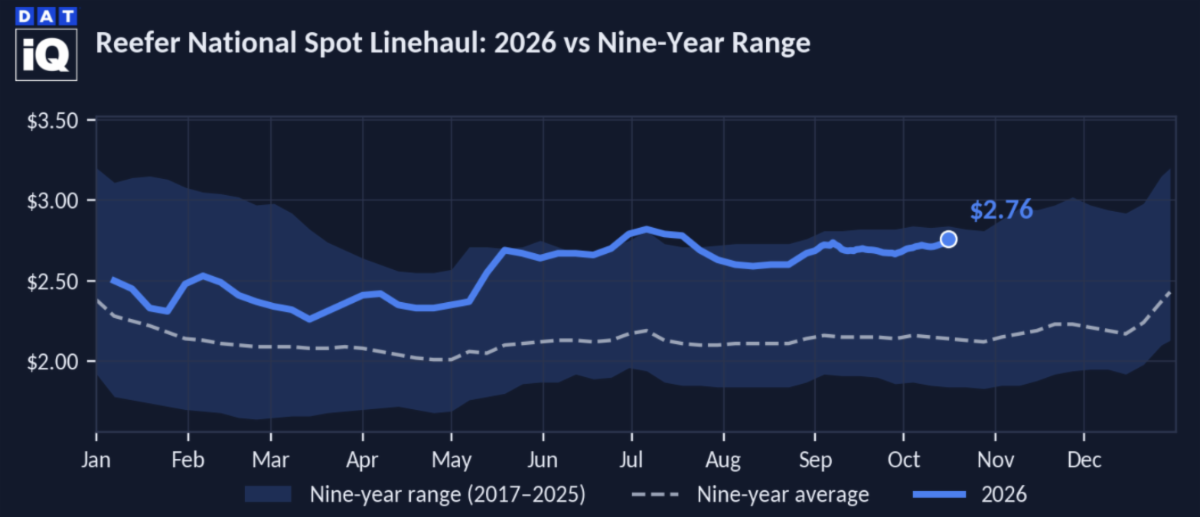
Refrigerated spot rates edged higher last week, even as load postings declined across the market. Tight truck availability continues to support carrier pricing, keeping rates well above last year’s levels and historical seasonal averages.
Although freight activity has slowed, limited capacity continues to provide a strong foundation for reefer pricing. With truck availability remaining constrained, carriers have maintained pricing leverage despite the seasonal decline in demand.
The Upper Midwest recorded the largest weekly rate increase, climbing $0.13 to $3.65 per mile, followed by the Lower Midwest, which gained $0.10. The Lower Mountain region also strengthened, rising $0.07, while the Great Lakes experienced the sharpest decline, dropping $0.04.
Looking ahead, DAT forecasts reefer spot linehaul rates will rise modestly to $2.78 per mile over the next 35 days. While regional volatility remains a factor, tight capacity and historically elevated rates suggest refrigerated carriers could maintain their pricing advantage heading into November.
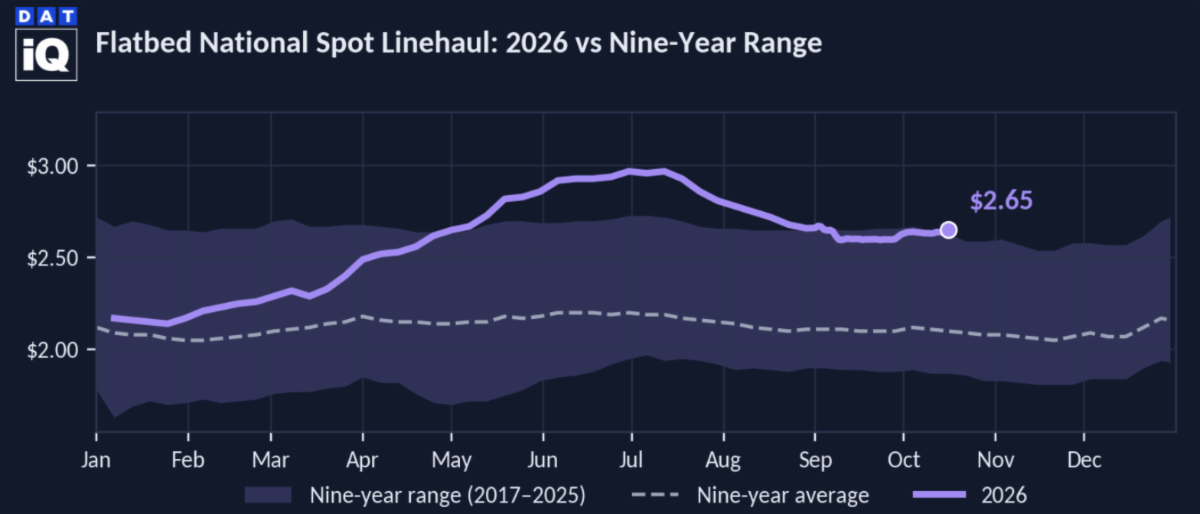
Flatbed remained the tightest of the three major equipment markets last week, with its load-to-truck ratio increasing while dry van and reefer ratios declined. Although spot rates slipped slightly, stronger freight activity and shrinking truck availability continue to support pricing well above historical levels.
Flatbed was the only equipment type to experience a tightening load board, with its load-to-truck ratio more than three times that of dry van. The combination of improving load activity and declining truck availability continues to favor carriers, even as national rates show signs of modest softening.
The Lower Mountain region recorded the largest weekly rate increase, climbing $0.06 to $1.76 per mile, followed by California, which gained $0.01. The Carolinas held steady, while the Southeast experienced the sharpest decline, dropping $0.09 to $3.07 per mile.
Looking ahead, DAT forecasts flatbed spot linehaul rates will ease to $2.59 per mile over the next 35 days, with a projected range of $2.52 to $2.65. Despite the anticipated decline, tight capacity and historically elevated pricing suggest flatbed carriers will maintain a relatively strong position heading into November.

KCH is teaming up with Truck Parking Club to help drivers find safe, legal parking, without the scavenger hunt.
Use code KCH25 at checkout for $25 off your next reservation.
Less time circling the lot. More time doing literally anything else.

We’re now posting freight on the Trusted Freight Exchange (TFX), a secure, Highway-powered network made for verified carriers like you.
It’s built right into Highway, free to use, and designed to connect you with quality freight fast.
Every KCH load on TFX is:
With TFX, you skip the back-and-forth and get straight to hauling.
Designed for shippers who want straightforward market insight and smarter freight strategies.