

Good morning, and welcome to The Cargo Club!
Today marks the 33rd anniversary of one of the most absurd moments in professional sports history, and I genuinely cannot believe this actually happened.
On November 6, 1993, Evander Holyfield and Riddick Bowe were fighting for the heavyweight championship at Caesars Palace in Las Vegas.
Two of the most dangerous men on the planet were beating the hell out of each other in front of thousands of spectators when, during the seventh round, a man named James Miller decided the evening needed a little more excitement.
So he flew a motorized paraglider directly into the boxing ring.
I’m not exaggerating. This man strapped a giant fan to his back, took to the skies above Las Vegas, and crash-landed into the ropes of a heavyweight championship fight.
His parachute became tangled in the overhead lighting, the fight was stopped for 21 minutes, and several members of Bowe’s security team responded by beating the absolute brakes off him.
Miller, who appropriately became known as “Fan Man,” was eventually escorted away by police. Holyfield went on to win the fight by majority decision, but understandably, the evening is probably best remembered for the guy who dropped out of the sky completely uninvited.
And the most impressive part is that he managed to become the most talked-about person at a boxing match without throwing a single punch.
Marketing departments spend millions trying to accomplish that.
– Greyson Harris
The Headlines
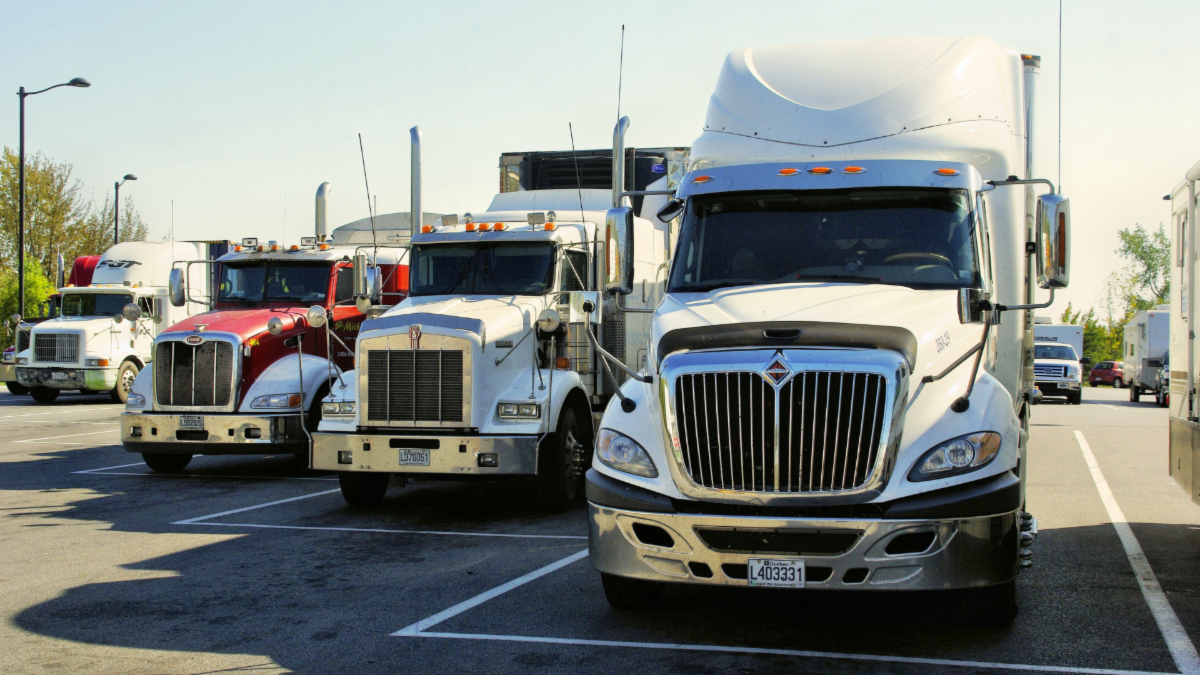
According to the Bureau of Labor Statistics (BLS), truck transportation employment remained unchanged in October, with the industry holding steady at 1,471,300 jobs.
That marks the first time in at least a decade that monthly employment figures have remained identical after revisions.
After years of job losses and shrinking capacity, the industry has decided that standing still is the next best thing to moving forward.
Aaaaand it’s gone
The latest numbers tell a slightly different story than last month’s report, thanks to some familiar statistical adjustments.
The September revision is particularly noteworthy because it effectively erased what had appeared to be the industry’s first year-over-year employment increase since early 2023.
Of course, these figures are still subject to revision, so the industry’s perfectly flat October could eventually become slightly less impressive.
Warehousing joins the waiting game
Trucking wasn’t alone in its lack of excitement. Warehouse employment also remained relatively flat, declining by just 300 jobs in October and sitting approximately 700 positions below last year’s levels.
The more interesting development is what these numbers suggest about available trucking capacity.
Jason Miller, a supply chain management professor, noted that the relatively stagnant truckload employment figures suggest any recovery in capacity is progressing extremely slowly. However, the numbers also indicate that the industry’s prolonged contraction may finally be leveling off.
Trucking companies aren’t rushing to hire, but they don’t appear to be shedding workers at the same pace either. That could provide some stability after years of declining freight demand, carrier closures, and shrinking capacity.
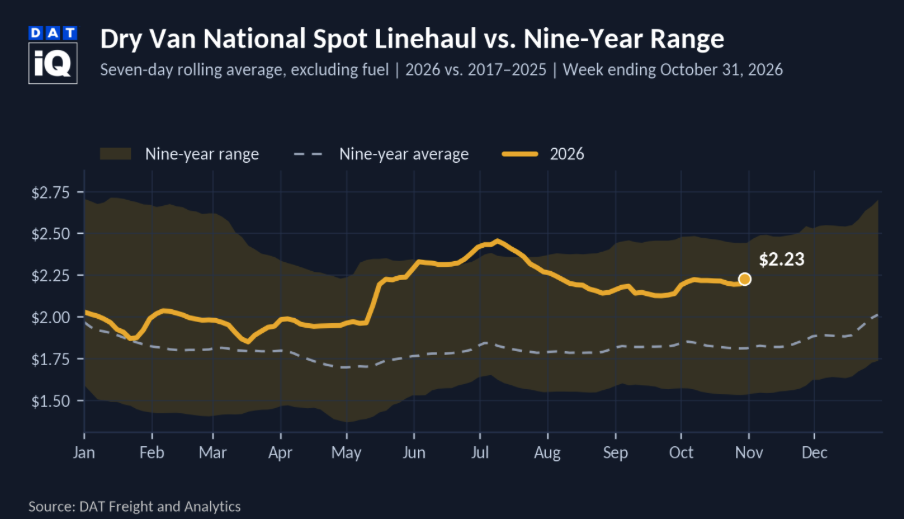
The dry van market found some momentum heading into November, with spot rates climbing as month-end freight demand picked up and available truck capacity continued shrinking.
Retail and e-commerce restocking helped push more loads onto the boards, while fewer carriers were around to haul them.
It’s a familiar supply-and-demand situation, except this time, the supply side seems determined to make things as inconvenient as possible for shippers.
All rates exclude fuel.
The combination of rising load volumes and shrinking truck availability is giving carriers some much-needed leverage. With fewer trucks competing for a growing pool of freight, spot rates have managed to climb well above typical seasonal levels.
Shippers hoping that the end of October would bring some relief are instead finding themselves competing for capacity that’s becoming increasingly difficult to find.
California was the only major origin region to post a weekly rate increase, climbing $0.04 to $2.62 per mile. The Lower Atlantic saw the steepest decline, falling $0.08, while the Great Lakes and Ohio River regions remained among the strongest markets despite modest decreases.
All 10 major regions continue to command higher rates than this time last year.
Looking ahead, DAT expects national spot rates to edge up to $2.26 per mile over the next 35 days, with a projected range of $2.19 to $2.33. Black Friday and Cyber Monday replenishment should keep distribution centers busy through early December, providing another seasonal boost to freight demand.
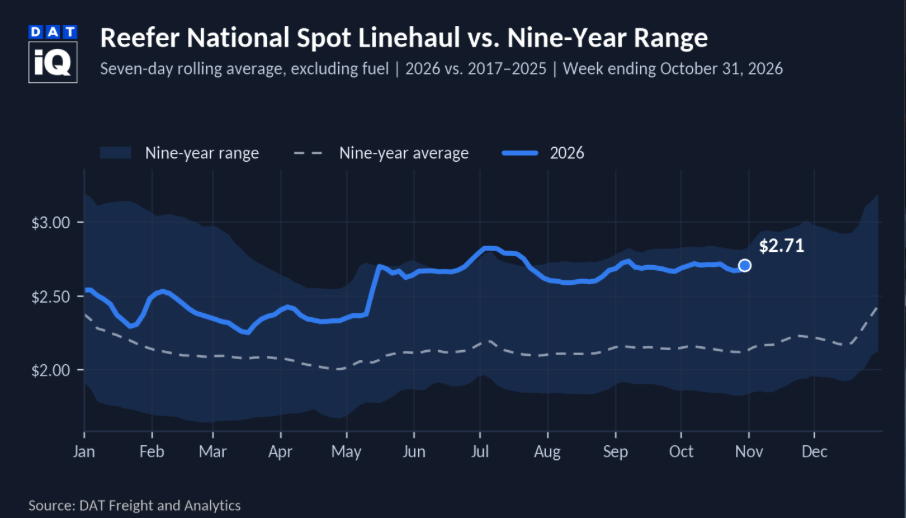
The refrigerated freight market is heating up heading into November, with spot rates climbing as available truck capacity continues to shrink. Load postings increased while fewer trucks were available to haul them, giving carriers a little more leverage just as holiday shipping demand begins picking up.
With Thanksgiving approaching, shippers are preparing to move everything from frozen turkeys to fresh produce, and refrigerated carriers are finding themselves in a pretty comfortable negotiating position.
All rates exclude fuel.
The combination of improving freight demand and shrinking capacity is keeping refrigerated rates elevated, even as produce shipments remain below last year’s levels. Carriers are benefiting from a tighter market, while shippers are facing fewer options and higher costs.
California led the major regions with a $0.04 per-mile increase, reaching $2.77, while the Lower Mountain region gained $0.03. Meanwhile, the Upper Midwest recorded the steepest decline, falling $0.17 to $3.43 per mile. The Ohio River region also softened considerably, dropping $0.14, although rates across all major regions remain higher than last year.
Produce markets offered some mixed signals. Texas shipments jumped 16% week over week, while California volumes declined 8%. Desert lettuce shipments roughly doubled, even as coastal lettuce volumes fell 28%. Despite softer overall produce activity, refrigerated produce rates out of Washington, California, and Texas continue to command substantial year-over-year premiums.
Looking ahead, DAT expects national reefer spot rates to reach $2.73 per mile over the next 35 days, with a projected range of $2.64 to $2.82. Thanksgiving demand for turkeys, dairy, produce, and other perishables should provide additional support as shipments move ahead of the holiday.
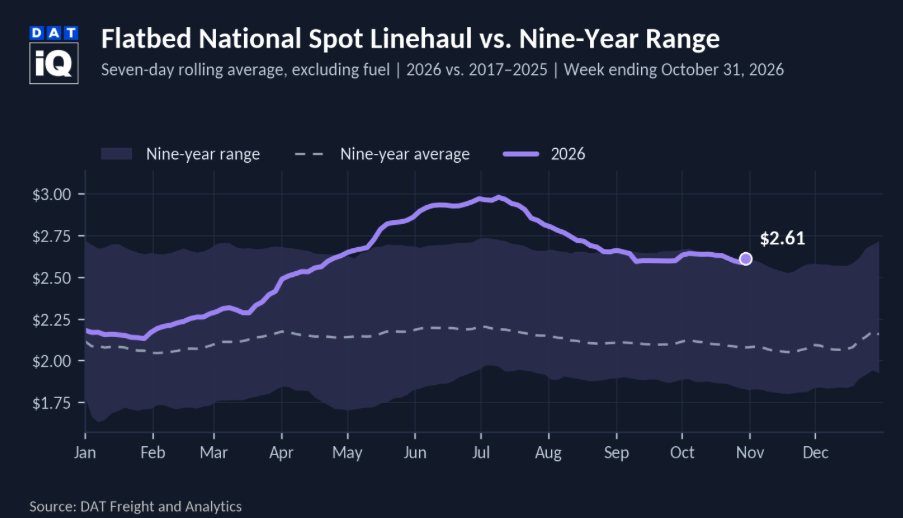
The flatbed market is tightening its grip heading into November, with spot rates inching higher as available truck capacity takes a significant hit. Load postings increased while truck availability dropped sharply, creating an increasingly competitive environment for shippers.
Flatbed was already the tightest of the three major equipment types, and apparently, it decided that wasn’t quite tight enough.
All rates exclude fuel.
The latest numbers reinforce flatbed’s position as the tightest equipment market, with its load-to-truck ratio running roughly 3.8 times higher than dry van’s. That doesn’t leave shippers with much room to negotiate, especially as available capacity continues disappearing from the boards.
Interestingly, spot rates haven’t increased nearly as dramatically as the capacity crunch might suggest, but carriers are still enjoying significantly stronger pricing than this time last year.
The Ohio River region and California led the week’s gains, each climbing $0.07 per mile to $3.24 and $2.25, respectively. Meanwhile, the Carolinas and Upper Atlantic experienced the steepest declines, both falling $0.13. The Southeast also softened, dropping $0.07 to $2.90, although all 10 major origin regions continue to command higher rates than a year ago.
Looking ahead, DAT expects national flatbed spot rates to ease slightly to $2.60 per mile over the next 35 days, with a projected range of $2.53 to $2.66. Construction and industrial freight typically slow around Thanksgiving as year-end projects wind down, which could help prevent further rate increases.
KCH is teaming up with Truck Parking Club to help drivers find safe, legal parking, without the scavenger hunt.
Use code KCH25 at checkout for $25 off your next reservation.
Less time circling the lot. More time doing literally anything else.

We’re now posting freight on the Trusted Freight Exchange (TFX), a secure, Highway-powered network made for verified carriers like you.
It’s built right into Highway, free to use, and designed to connect you with quality freight fast.
Every KCH load on TFX is:
With TFX, you skip the back-and-forth and get straight to hauling.
Designed for shippers who want straightforward market insight and smarter freight strategies.