


Good morning, and welcome to The Ship Show!
Tomorrow marks the annual gathering of people I share varying percentages of DNA with.
I’ve always found the concept of extended family fascinating. There are people on this planet who know an embarrassing amount about my childhood, yet I couldn’t tell you what they do for a living, where they live, or whether they’re still married to the person sitting next to them.
I love my family. I just think some of my relationships with them are operating at a perfectly sustainable frequency of once a year. Increasing that frequency could jeopardize an otherwise successful arrangement.
The biggest challenge is catching up on an entire year’s worth of developments in the time it takes to finish a plate of deviled eggs.
Since we last gathered:
There should really be a family newsletter distributed two weeks before Thanksgiving. Give me the major personnel changes, quarterly relationship updates, and a brief overview of any subjects that are currently off-limits. I’d happily review the material beforehand.
For those who’d rather skip the family debrief entirely, I’ve developed a few strategies for navigating Thanksgiving:
Once a year is a beautiful thing. It’s enough time to miss each other, but just enough time together to remember why we don’t do this more often.
It’s not that I’m antisocial. I just believe in maintaining healthy inventory levels of family interaction.
– Greyson Harris
In this week’s issue:

The Headlines

The tariffs that the Supreme Court struck down in February are making something of a comeback.
Different legal authority, different justification, but a very familiar headache for anyone importing goods into the United States.
The U.S. proposed new tariffs on 14 major trading partners this week, including China, the European Union, Japan, and South Korea, following an eight-month investigation into foreign manufacturing practices that Washington argues are putting American producers at a disadvantage.
Too much of a good thing
The investigation centers on what’s known as structural excess capacity, which is essentially when countries manufacture more goods than the market can reasonably absorb.
The administration argues that government subsidies and other financial incentives allow foreign manufacturers to flood international markets with inexpensive products, making it difficult for American companies to compete.
China has received the bulk of Washington’s criticism, particularly for its production of steel, aluminum, electric vehicles, and solar panels. Beijing, unsurprisingly, maintains that its manufacturing success is a product of competitive advantages rather than unfair trade practices.
The administration intends to honor tariff ceilings established under existing trade agreements, meaning the new duties won’t necessarily be piled on top of everything importers are already paying.
The duties also won’t stack with the forced-labor tariffs introduced in July. That should spare importers at least one additional column in their increasingly elaborate Excel spreadsheets.
Different route, same destination
Rather than relying on the emergency powers that the Supreme Court determined did not authorize his original tariffs, Trump is utilizing Section 301 of the Trade Act of 1974, which allows the U.S. to respond to foreign trade practices deemed unfair.
The proposed duties must still undergo a public comment period and hearing before taking effect, potentially pushing implementation into January.
That leaves plenty to discuss at next month’s G20 summit in Miami, where several of the affected trading partners will be in attendance.
The U.S.-China trade truce is also scheduled to expire on January 10, adding another layer of uncertainty to the negotiations.

The trucking industry has made some encouraging progress on the safety front in recent years, with serious commercial vehicle crashes continuing to decline from their 2022 peak.
But before we hang a “Safety First” banner in the break room and call it a day, there’s a little more to the story.
Fewer crashes don’t necessarily mean the roads are getting safer, particularly when there are fewer trucks operating on them.
And with December right around the corner, the industry is approaching one of its historically more dangerous months.
A closer look at the numbers
According to FreightWaves SONAR data:
States have up to 90 days to submit crash reports to federal regulators, meaning recent declines may have more to do with administrative backlogs than actual improvements in road safety.
The reduction in fatal crashes, however, has significantly outpaced the contraction in carrier capacity, which means the industry’s safety efforts are making a meaningful difference.
Fewer trucks, fewer crashes
One of the more complicated aspects of measuring trucking safety is accounting for how much trucking is actually taking place.
As of November 13, the number of tractors operating in for-hire fleets had fallen by roughly 107,000 compared to a year earlier.
Naturally, fewer trucks on the road means fewer opportunities for accidents. It’s the statistical equivalent of improving your golf handicap by playing fewer rounds.
When adjusted for the number of carriers in operation, overall crash frequency between 2022 and 2025 remained relatively flat.
December danger
The final month of the year offers a rather unfortunate combination of winter weather, limited daylight, increased holiday traffic, and time-sensitive freight.
Throw in millions of motorists who suddenly remember they need to purchase Christmas presents, and you’ve got a less-than-ideal operating environment for professional drivers.
Last December was particularly rough for commercial vehicles:
Dry van, reefer, and other enclosed equipment have accounted for nearly 47% of reported commercial vehicle crashes so far this year. That doesn’t necessarily mean those trailers are more dangerous, but it does highlight how much exposure exists within the equipment segments handling the bulk of holiday retail and grocery freight.
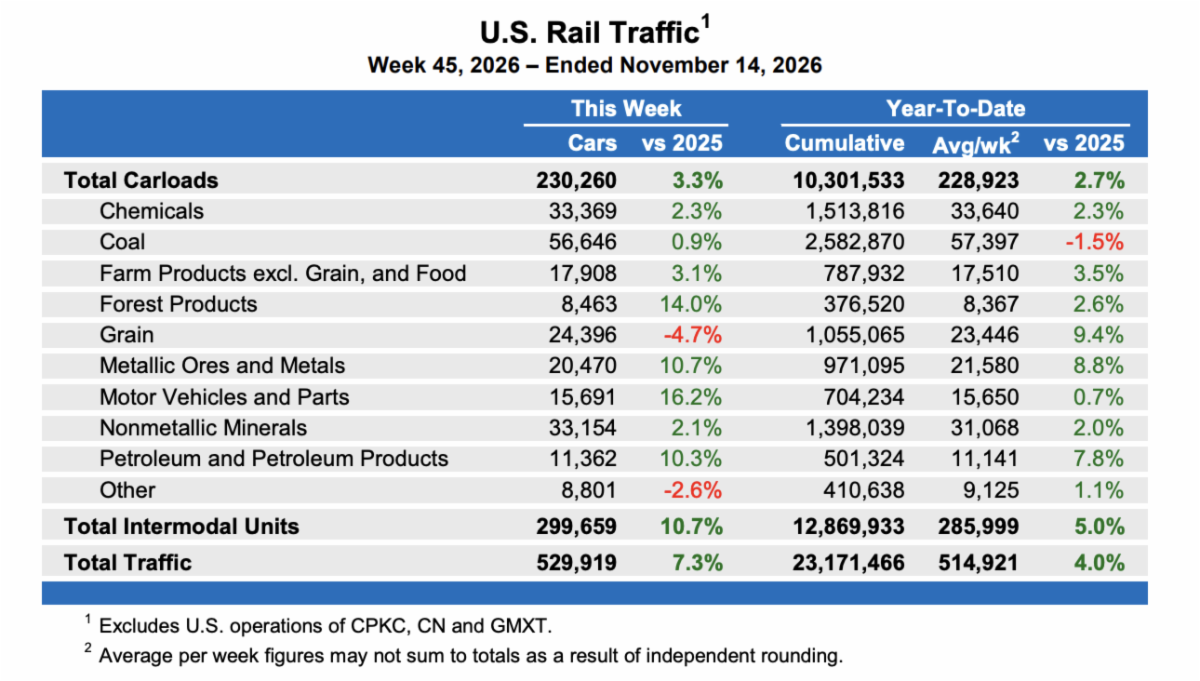
🚂 Intermodal leads another strong week for rail: U.S. rail traffic rose 7.3% year over year to 529,919 carloads and intermodal units during the week ending November 14. Intermodal volumes climbed 10.7%, while conventional carloads increased 3.3%, with eight of the 10 major commodity categories recording gains. Motor vehicles and parts led commodity growth at 16.2%, followed by forest products at 14% and metallic ores and metals at 10.7%. Through the first 45 weeks of 2026, total U.S. rail traffic is up 4% compared to the same period last year.
🚢 Ocean rates ease but remain elevated: Trans-Pacific spot rates declined in the week ending November 19, with Asia-to-U.S. West Coast rates falling 1.7% to $8,203 per FEU and East Coast rates dropping 1.9% to $10,901, according to Xeneta. Despite the weekly declines, rates on both lanes remain roughly 300% above year-ago levels. Offered capacity has increased by approximately 11% on both routes over the past month, contributing to downward pricing pressure.
✈️ Airfreight rates climb for seventh straight week: Global average air cargo rates rose 2% to $3.49 per kilogram during the week ending November 15, according to WorldACD Market Data. The increase came as worldwide capacity declined 2% and cargo volumes fell 4%, driven partly by Diwali-related disruptions in South Asia and the recent U.S. aviation outage. Central and South America recorded the largest regional rate increase at 6%, followed by Africa at 4%.
⛽️ Diesel prices take another dive: The DOE/EIA average retail diesel price fell 24.2 cents to $5.695 per gallon this week, marking the largest weekly decline since the Iran war began and the fourth consecutive week of falling prices. The benchmark used to calculate most fuel surcharges has dropped 65.7 cents over the past month and now sits 83.4 cents below its September 22 record high. Despite the recent relief, diesel remains nearly $1.80 per gallon more expensive than it was before the conflict began in March.

Having already released a fresh batch of UFO documents this year, the federal government is now giving America’s favorite notoriously unphotogenic woodland resident some attention.
The U.S. Forest Service quietly published three historical documents concerning Bigfoot on October 15. The files, available through its Freedom of Information Act reading room, detail alleged encounters and investigations in Montana and Oregon dating back to 1949.
Yes, there is an actual section of a federal government website dedicated to Sasquatch records.
Sasquatch stories
The documents cover three separate incidents, each offering varying degrees of evidence and material for your uncle to bring up at Thanksgiving dinner tomorrow.
FBI: Federal Bigfoot Investigators
In 2019, the FBI released its own Bigfoot files, revealing that the bureau had analyzed hair samples submitted by a Sasquatch researcher in the 1970s.
The samples belonged to a deer. Bummer, I know.
It’s worth remembering that this was during the Cold War, meaning somewhere within the federal government’s national security apparatus, an employee was tasked with determining whether a clump of hair belonged to a mythical forest giant.
Have you seen this creature?
Not to be a party pooper, but none of the newly released documents provide definitive evidence that Sasquatch exists.
Anthropologists remain skeptical, and the most thorough investigation in the collection actually makes a stronger case for human involvement than an undiscovered primate.
Still, Bigfoot believers are hopeful that the release signals a greater willingness by federal agencies to share information about alleged encounters.
Personally, I find it remarkable that we’ve developed satellites capable of monitoring individual shipping containers, phones capable of shooting video in 8K, and trail cameras that can detect a squirrel at three in the morning, yet every photograph of Bigfoot still looks like it was taken through a microwave door.
A purported eight-foot-tall mammal has spent decades evading every government agency, wildlife camera, and unemployed guy with a GoPro in North America.
At this point, if he does exist, we should probably respect his wishes.



We’re now posting freight on the Trusted Freight Exchange (TFX), a secure, Highway-powered network made for verified carriers like you.
It’s built right into Highway, free to use, and designed to connect you with quality freight fast.
Every KCH load on TFX is:
With TFX, you skip the back-and-forth and get straight to hauling.

The U.S. has 23 million truck parking spots. You should be able to find one without feeling like you’re on a wild goose chase.
We’re teaming up with Truck Parking Club to make that happen.
Use code KCH25 for $25 off your next reservation.
Less wandering. More rest.
Designed for shippers who want straightforward market insight and smarter freight strategies.