Good afternoon, and welcome to The Cargo Club!
Happy Global Cat Day to all who celebrate.
I grew up in a dog-only household, so for most of my childhood, I operated under the assumption that dogs were objectively the superior pet. They’re loyal, affectionate, and genuinely thrilled by your existence. What’s not to love?
But somewhere along the way, I became a cat guy. And I don’t think there’s any going back.
Cats are incredible. They’re independent enough that you don’t have to plan your entire day around their bowel movements, but needy enough that they’ll follow you from room to room just to make sure you’re not enjoying yourself without them. It’s like having roommates who don’t pay rent but occasionally cuddle with you, which, frankly, is a better arrangement than some roommates I’ve had.
And the entertainment value is unmatched. You can spend $40 on an elaborate cat toy, and they’ll ignore it entirely in favor of the cardboard box it came in. They’ll sprint through your house at 3 a.m. for reasons that have yet to be explained by science. They’ll knock something off a table while maintaining direct eye contact, just to remind you that property ownership is a social construct.
My two cats, Anakin and Freddie, have pretty much convinced me that cats have figured out the ideal way to live. Sleep 16 hours a day, eat whenever possible, demand affection exclusively on your terms, and occasionally scream at someone for opening the wrong door.
And somehow, despite contributing absolutely nothing financially, they’re the ones running the household.
Honestly, I respect it.
– Greyson Harris
The Headlines
Uncle Sam Is Making Room for More Truckers
Finding a place to park an 80,000-pound truck shouldn’t feel like competing for a spot at Costco the Saturday before Thanksgiving. Unfortunately, for thousands of American truck drivers, finding somewhere safe to stop for the night has become one of the more frustrating parts of the job.
Fortunately, the federal government is finally making some room.
On Wednesday, the U.S. Department of Transportation announced $200 million in federal grants to fund 2,403 new truck parking spaces across 12 states. The funding will support 14 projects through the Nationally Significant Multimodal Freight & Highway Projects (INFRA) program, targeting some of the country’s busiest freight corridors.
A little more breathing room
The largest project is happening right here in Tennessee, where nearly $24 million will fund 500 new parking spaces at five Pilot Travel Center locations along Interstates 40 and 24, including areas near Nashville and Knoxville.
Other notable projects include:
- Texas: 305 spaces near the Los Indios border crossing with Mexico.
- Georgia: 275 spaces near the Port of Savannah, plus 109 additional spaces in Monroe County.
- Connecticut: 260 spaces at a new facility along I-91 in Enfield.
- Iowa: 150 spaces spread across six existing rest areas along I-80.
- North Carolina: 140 spaces at the Port of Wilmington, along with approximately 50 container staging positions.
Additional projects are planned in Arkansas, Nebraska, Wisconsin, California, Minnesota, and Illinois.
The funding will go to public agencies and eligible public-private partnerships, meaning the government can work with private operators to expand parking without having to get into the truck stop business itself.
The parking problem nobody wants to deal with
The shortage of truck parking has been a persistent headache for years, and it’s costing drivers more than just their patience.
According to the DOT, roughly 40% of truckers spend more than an hour each day searching for somewhere to park. Research from the American Transportation Research Institute estimates that drivers lose an average of 56 minutes daily finding safe parking, cutting into their productivity and earning potential.
Truck parking was also the second-biggest concern among drivers in ATRI’s 2025 industry survey, trailing only compensation.
And the problem goes beyond inconvenience. When drivers approach their federally mandated hours-of-service limits without an available parking space, they’re left with increasingly unpleasant options: keep driving to find somewhere legal, stop early and sacrifice productive hours, or risk parking somewhere unsafe.
None of those options is particularly appealing, especially after spending most of the day behind the wheel.
Trailer Trends:
Tight Capacity Keeps Dry Van Rates Elevated
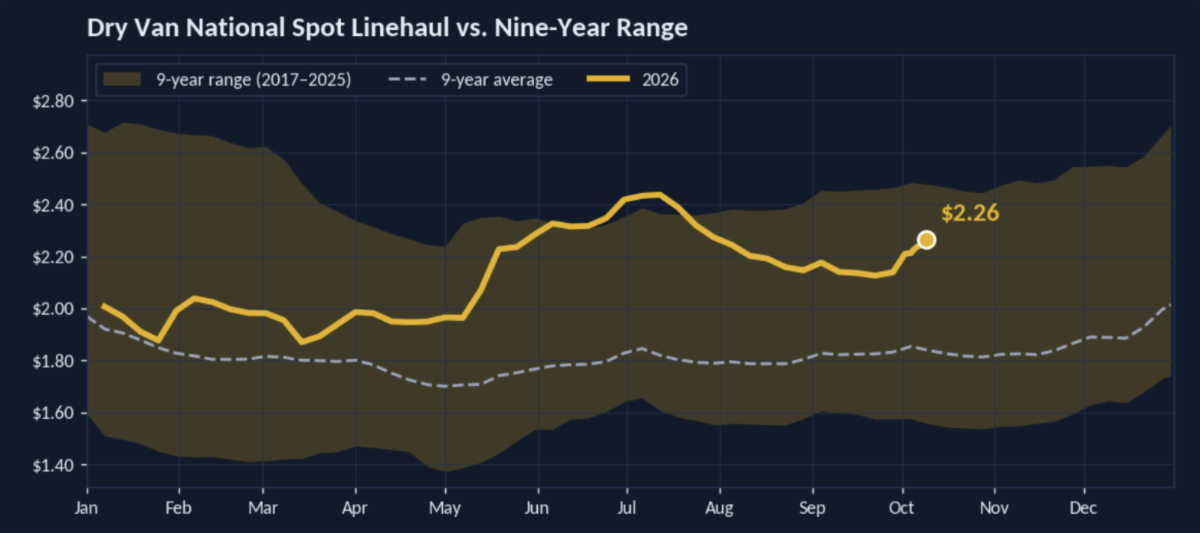
Dry van spot rates continued climbing last week, even as freight activity slowed following the quarter-end surge. With fewer loads hitting the boards and capacity remaining tight, carriers continued to benefit from a market that looks considerably stronger than it did a year ago.
Rates rise despite slower freight activity
The latest DAT figures show a market where declining freight volume hasn’t translated into lower rates.
- National linehaul rate: $2.26 per mile, excluding fuel, up $0.05 (2.4%) week over week.
- Year-over-year comparison: Rates are up $0.59 (35.1%) and sit 23% above the nine-year seasonal average.
- Load postings: Down 20.4% from the previous week.
- Truck postings: Up 4% week over week.
- Load-to-truck ratio: Fell from 13.72 to 10.50, but remains well above last year’s 6.29.
While the post-quarter-end rush has faded, capacity remains constrained enough to keep rates elevated. The decline in the load-to-truck ratio suggests some easing in market pressure, but carriers are still operating with considerably more leverage than they had at this point last year.
Regional markets and the road ahead
California and the Ohio River region led weekly rate gains, each increasing $0.07 per mile. The Great Lakes and Upper Atlantic also strengthened, while the Lower Midwest and Florida-South Georgia saw modest declines.
Looking ahead, DAT projects national linehaul rates will ease to approximately $2.23 per mile over the next 35 days. That would represent a slight pullback from current levels, but the broader market remains significantly tighter than it was a year ago.
 Reefer Rates Defy Seasonal Slowdown
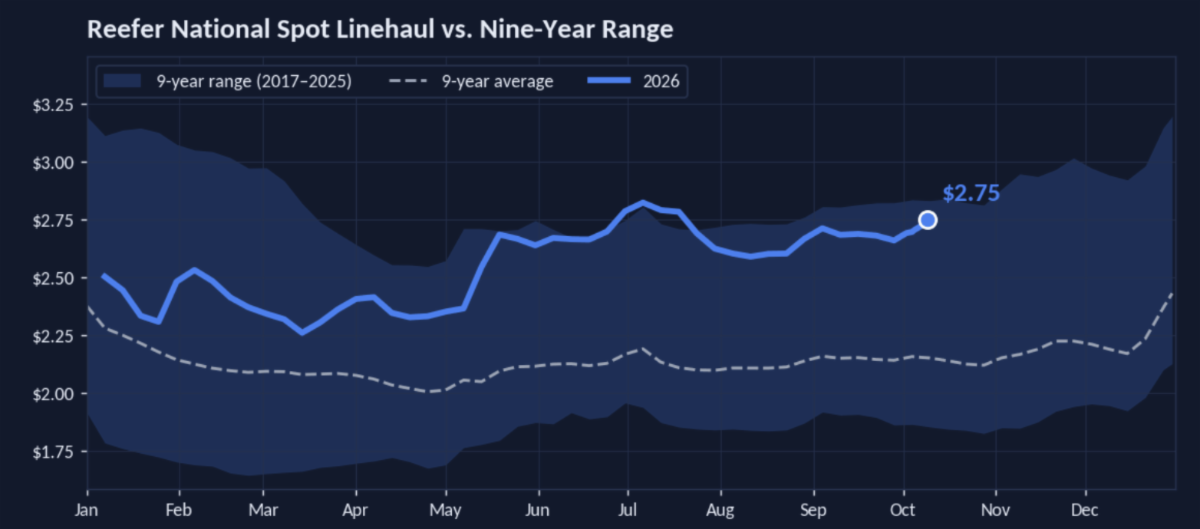
Reefer spot rates continued climbing last week, even as freight activity slowed following the quarter-end surge. With load postings falling sharply and available capacity still relatively constrained, the market continues to favor carriers despite softer demand.
Rates rise as freight volume falls
The latest DAT figures show refrigerated freight activity cooling, but not enough to reverse the upward pressure on rates.
- National linehaul rate: $2.75 per mile, excluding fuel, up $0.06 (2.1%) week over week.
- Year-over-year comparison: Rates are up $0.68 (32.7%) and sit 27.6% above the nine-year seasonal average of $2.15.
- Load postings: Down 20.7% from the previous week.
- Truck postings: Up 2.4% week over week.
- Load-to-truck ratio: Fell from 21.65 to 16.75, but remains 56.5% above last year’s 10.71.
Much of the decline in freight activity reflects the clearing of shipments that accumulated at the end of the third quarter. Despite fewer available loads and a slight increase in truck postings, capacity remains tight enough to support higher rates. The continued pricing strength suggests that available capacity, rather than surging demand, is driving the market.
Regional trends and the road ahead
Regional performance was mixed, with the Upper Midwest leading weekly gains while the Upper Atlantic experienced the largest decline.
- Upper Midwest: Rates increased $0.09 to $3.51 per mile.
- Great Lakes and Ohio River: Both regions gained $0.07 per mile.
- Upper Atlantic: Rates declined $0.07 to $2.75 per mile.
- 35-day forecast: DAT projects rates will edge up to $2.77 per mile, with a projected range of $2.68 to $2.86.
Looking ahead, refrigerated freight rates are expected to remain elevated, although DAT’s wider forecast range suggests greater uncertainty than in the dry van and flatbed markets. For now, tight capacity continues to provide a floor for pricing, even as seasonal freight demand begins to ease.
 Flatbed Rates Resist Seasonal Slowdown
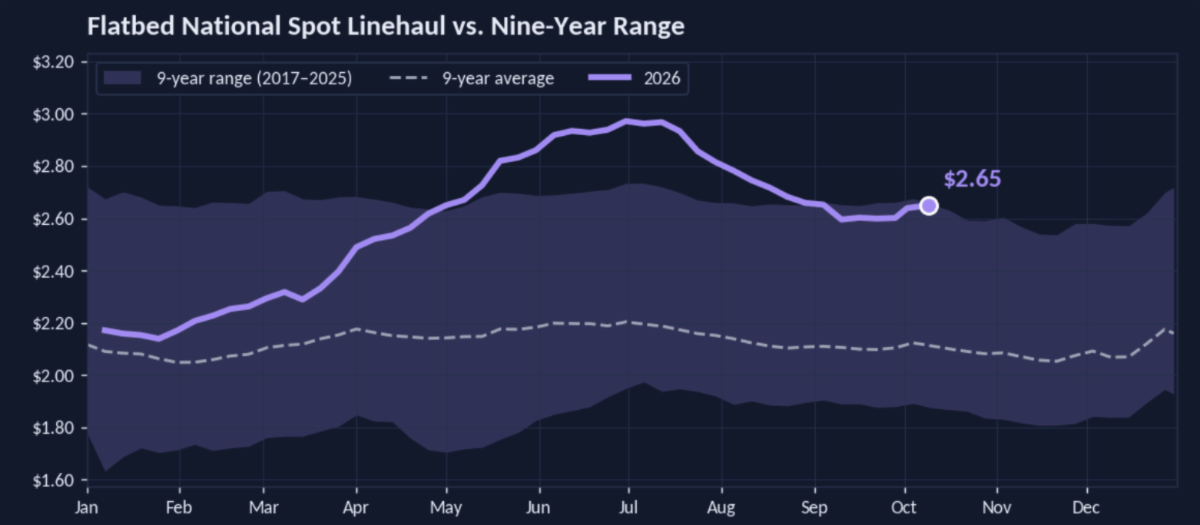
Flatbed spot rates held near the top of their historical range last week, even as freight activity slowed and more trucks returned to the market. While the post-quarter-end rush appears to be fading, capacity remains relatively tight, keeping rates elevated despite softer load volumes.
Rates hold firm as load postings decline
The latest DAT figures show flatbed rates maintaining their strength, with market conditions remaining considerably tighter than a year ago.
- National linehaul rate: $2.65 per mile, excluding fuel, up $0.01 (0.4%) week over week.
- Year-over-year comparison: Rates are up $0.59 (28.8%) and sit 25.4% above the nine-year seasonal average of $2.11.
- Load postings: Down 12.5% from the previous week.
- Truck postings: Up 5.6% week over week.
- Load-to-truck ratio: Fell from 44.13 to 36.60, but remains 34.8% above last year’s 27.16.
Although freight activity has softened, flatbed experienced the smallest decline in its load-to-truck ratio among the three major equipment types. The market’s resilience suggests that available capacity remains limited enough to support pricing, even as demand begins to ease.
Regional trends and the road ahead
Regional performance was mixed, with the Carolinas and Great Lakes leading weekly gains while several eastern markets experienced declines.
- Carolinas: Rates jumped $0.19 to $3.00 per mile.
- Great Lakes: Rates increased $0.11 to $2.91 per mile.
- Southeast: Rates declined $0.04 to $3.16 per mile.
- Upper Atlantic: Rates fell $0.05 to $2.61 per mile.
- 35-day forecast: DAT projects rates will ease to $2.59 per mile, within a forecast range of $2.52 to $2.65.
Looking ahead, flatbed rates are expected to soften modestly as seasonal demand slows. However, DAT’s relatively narrow forecast range suggests a more predictable short-term outlook than in the dry van and reefer markets. For now, limited capacity continues to provide support for pricing, keeping the market well above last year’s levels.
Keeping Up With KCH:
Truck Parking Sucks - Let's Fix That.
KCH is teaming up with Truck Parking Club to help drivers find safe, legal parking, without the scavenger hunt.
Use code KCH25 at checkout for $25 off your next reservation.
Less time circling the lot. More time doing literally anything else.
Book Our Loads on Highway's TFX
We’re now posting freight on the Trusted Freight Exchange (TFX), a secure, Highway-powered network made for verified carriers like you.
It’s built right into Highway, free to use, and designed to connect you with quality freight fast.
Every KCH load on TFX is:
- Verified: posted by trusted shippers and brokers.
- Ready to roll: book it instantly and get moving.
With TFX, you skip the back-and-forth and get straight to hauling.
Get your SYLTD t-shirt
Support Your Local Truck Driver T-Shirt
$39.95
Connect with us on our social pages!